Vacuum
 |
This article relates to content added by Odyssey (DLC). Please note that it will not be present without the DLC enabled. |
Vacuum is an environmental factor unique to locations in orbit, and represents the amount of breathable air within a room. Vacuum management is a vital consideration during trips into orbit and especially for spacebound colonies; plants will die if even briefly exposed to vacuum, and most living pawns will be severely endangered if caught in airless environments without sufficient protection.
Vacuum is never a consideration on planet-bound maps. In such locations, all tiles are always considered to be fully pressurized.
Summary[edit]
Measurement[edit]
Vacuum is measured as a percentage per cell. A cell with 100% vacuum is considered to be completely depressurized, while a cell with 0% vacuum is considered to be fully pressurized. All tiles within a room share the same vacuum level.
The vacuum level of a tile is listed in the tile's information area located above the Architect menu, just above its light level. A vacuum overlay can also be toggled on and off from the bottom right corner of the screen, and will visualize the vacuum level from red (100%) to green (0%).
Airtight rooms with at least 50% vacuum will have a visible overlay resembling gray clouds and white motes of dust, with its visibility inversely scaling with vacuum level; at 50% vacuum, the overlay will be nearly transparent, while at 100% vacuum it will be totally visible.

Pressurization[edit]
In orbit, all outdoors areas are always considered to be a complete vacuum, no matter what.
Each building is designated as airtight or not airtight, visible in its information window. In order for a room to be pressurized, it must be airtight: it needs to be completely enclosed by airtight structures, as well as entirely roofed and not having any gaps of Space on the ground. Walls and doors are considered airtight if made out of metallic stuff types (excluding obsidian, but including bioferrite ). Doors and vents will exchange vacuum when opened;[What rate?] powered vac barriers can be used to allow passage while keeping pressure in.
Once a room is airtight, they can be pressurized with oxygen pumps or archean trees, reducing the vacuum level of the room. Life support units can be found in some naturally-generating locations and faction bases that pressurize the room they are in at no cost, but they cannot be moved or deconstructed.
Effects[edit]
Vacuum is very dangerous for unprotected pawns, causing vacuum exposure and vacuum burns, the former being lethal in as little as 3,000 ticks (50 secs).
Vacuum exposure[edit]
Without 100% Vacuum Resistance, a human or animal that enters a tile with at least 50% vacuum will immediately begin suffering from vacuum exposure. This reduces Consciousness and increases pain, eventually causing unconcsiousness at 85% exposure and death at 100%. The rate of exposure increase every 60 ticks (1 sec) is:
Increase in vacuum exposure severity = 0.02 * tile vacuum percentage * (1 - vacuum resistance)
With 0% Vacuum Resistance and a 100% vacuum tile, a pawn will reach 100% vacuum exposure and die at 3,000 ticks (50 secs), and will become unconcious at 2,550 ticks (42.5 secs).
A downed pawn can be saved from further vacuum exposure by being carried by another pawn.
Vacuum burns[edit]
 |
This section is a stub. You can help RimWorld Wiki by expanding it. Reason: needs injury type definitions in the relevant locations. |
Pawns in at least 50% vacuum will suffer periodic vacuum burn injuries to random external body parts that are not covered by vacuum-resistant gear. This happens at an interval scaling linearly from one burn every 1,200 ticks (20 secs) at 50% vacuum to one burn every 300 ticks (5 secs) at 100% vacuum. Vacuum burns deal a flat 1-2 damage each - regardless of multipliers to incoming damage such as the Tough trait - and will combine together when inflicted to the same body part.
Vacuum burns never scar, and cannot become infected. This makes them mostly a tertiary danger compared to vacuum exposure, but the penalties caused by compounding burns can still add up to become a significant danger.
Pawns with the vacuum resistant or breathless genes, as well as pawns with the vacskin gland,
 will never suffer vacuum burns.
Other effects[edit]
Roughly every hour, plants other than archean trees will instantly die if they are exposed to at least 50% vacuum.[Checks on long ticks -- describe more accurately?]
Fire and gases will dissapate rapidly in a vacuum.
Note that pawns in vacuum protective gear can still eat and sleep while in a vacuum without gaining extra exposure.
Analysis[edit]
Before launching into space, make sure that all venturing colonists have appropriate Vacuum Resistance, and if using a gravship or making a permanent colony, it is good for each important room to be airtight and have proper heating and pressurization. Having multiple differnt airtight sections, with each one having heaters/oxygen pumps, will help in case one gets breached.
The vacsuit and vacsuit helmet is the cheapest and easiest to research armor that lets pawns travel safely in orbit, but comes at a major move speed penalty. Power armor can allow for pawns to stay in days in orbit, ranging from 51,000 ticks (0.85 in-game days) until unconciousness with recon helmet + any power armor, to 127,500 ticks (2.13 in-game days) with a cataphract helmet + any power armor.
The vacuum resistant gene alone is not enough for safe vacuum travel, but it will provide some insurance against short, accidental, exposures, and allows pawns to wear power armor with 100% resistance. The breathless gene provides 100% immunity to vacuum, but pawns will still need to be prepared for the -75 °C (-103 °F) temperature in orbit.
Gallery[edit]
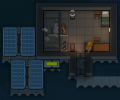
A practical example of a simple unpowered airlock. Note the doors constructed in sequence.

Version history[edit]
- Odyssey DLC Release - Added.
- 1.6.4543 - Fix: Vacuum overlay not updating after gravship takeoff.