Defense structures
 |
This article is suggested to be rewritten. Reason: Everything past early-game should to be updated to 1.6, e.g., barricades no longer prevent enemies from using cover. You can help the RimWorld Wiki by improving it. |
 |
This page could use some more or updated images. You can help RimWorld Wiki by uploading images to make this page better. Note: Most images are from Beta 18, where deadfall/spike traps could be placed adjacent to each other.. |
Raids are frequent and numerous as enemies don't journey towards your base from their bases; they are instead generated into your colony by the storyteller. Players will need to fight the enemy AI for each type of hostile, but the approach may differ according to gameplay preferences, either face to face for a more combative experience or behind killboxes for a less threatening measure, or both combined.
Map features[edit]
Before laying blueprints, first inspect the map for natural features that can work as defenses, such as water or a mountain.
Water[edit]
Water and marsh tiles can be used as moats, which will considerably slow down incoming Raiders, giving you some time to shoot and soften the clash before engaging in melee combat. You can build cover, like barricades just in front of the body of water.
If large bodies of water are available, such as rivers or lakes, then bridges can be used to manipulate raider AI by encouraging them to path through the faster bridge.

Mountains[edit]
In mountainous and hilly maps, it is possible to build defenses by enclosing the area between two hills. In an actual mountain map, it is often best to mine into the mountain and live inside, but this may be too time-consuming in the early game.
Map borders[edit]
Pay attention when expanding towards the edges of the map, as there's a boundary which your colonists can not build beyond that is only visible when the Structure tab is selected.
Early-game defense[edit]
At the very beginning, your security choices include spike traps, cover (including barricades, sandbags, and stone chunks),
Stone chunks[edit]
At the very beginning of the game, colonists will often haul stone chunks away to build structures or to clear up a growing zone. As colonists move stone chunks around, it's recommended to create a dumping stockpile zone for chunks to cover the perimeter of your base. This is time-consuming, so only a 1-tile-wide line of chunks is enough for the early game.

Walls[edit]
Walls alone can fend off early game raids if a colonist's Construction skill is high enough to repair the wall faster than the raider can break it. A walled room will also completely defend against manhunter and carnivore attacks, who will not attack if every colonist remains indoors.
Otherwise, walls are nearly essential for luring raiders into the area you want to fight them in. Standard raiders will always try to take the quickest, unobstructed path towards a colonist if such a path exists. This means that standard raiders will not try and break walls unless they are unable to reach a target. This is the key towards most defensive structures, and can be used to construct trap hallways, chokepoints for melee fighters, strategic cover placements, and so on.
Material: Wood is cheap and quick to build, but weak and flammable. Stone is ideal, being cheap, durable, and nonflammable, but time-consuming. Steel walls are flammable in RimWorld. Plasteel and uranium are the strongest walls but are expensive, and should generally be reserved in specific spots.
Cover[edit]
Cover is vital for firefights as it can block projectiles, reducing the amount of damage received by your colonists. This is an essential defense as long as colonists or turrets are directly engaging.
- Walls provide 75% cover, but pawns need to "lean out" whenever firing, causing the wall to not provide its full cover. In addition, walls block line of fire.
- Barricades and sandbags provide 55% cover and do not block line of fire.
- Stone chunks only provide 50% cover, which is great in the early game, but should be replaced by 55% cover when possible.
The best arrangement of cover is a mix of walls and barricades/sandbags, as a pawn can benefit from barricades whenever they lean out from a wall. The exact ratio will depend on what angles the colonist needs to fire at, as wall tiles will limit how far a colonist can turn. Creating a U shape of cover, or a square around the colonists will ensure that they can engage enemies from multiple angles.
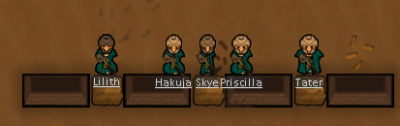
Example of advanced cover, mixing walls and barricades.
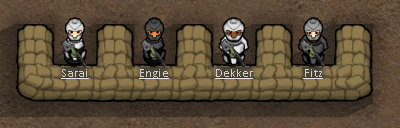
Example of advanced cover using sandbags only.
Allows full range of fire, but less cover overall.


Spike traps[edit]
The only initially available defense that deals damage. Spike traps are single use and require careful placement. It is best to place spike traps where raiders will naturally walk through, or can be lured into, such as:
- Corners of your base, where enemies will likely make turns.
- Narrow areas even outside your base that receive frequent traffic.
- Chokepoints. If there is only one entrance to a room or the entire colony, raiders will have no option but to walk through it.
If it doesn't seem obvious to you at first, one way to find out is by carefully studying raids pathing from the map borders as they close in towards your base. Watch where they go through and starting laying blueprints but forbidding them (as you are currently being attacked).
When building spike traps, you must also leave free areas so that your colonists and friendlies can pass harmlessly, or they may accidentally step on a spike trap while exiting or trying to rearm them. As such, putting them in a 1-wide corridor is not a good idea.
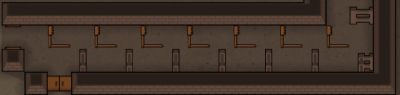
Trap and fence tunnel

Traps in potential enemy cover spots (map border)


Instead, a good way to use traps is as shown above: build a 2-wide corridor as the only entrance to the base, with a spike trap, then a fence next to it. Raiders cannot open the colony's doors and do not see traps, meaning they will walk over the "faster" lane with the traps on it. Colonists will walk through the fences or use the doors.
Materials: Wood spike traps are practical for most biomes in the early game. It is flammable, so it is ideal but not close to required to place them in stony or floored areas, or roof over the area so grass won't grow. Stone traps are more damaging and nonflammable but take a long time to build. Steel is faster than stone and more damaging still in case traps are urgently needed or steel is abundant.
Bait furniture[edit]
Attackers will destroy furniture if there is no unobstructed path to a colonist, and will sometimes even stop to destroy furniture if it is between them and the nearest colonist. They may smash items or set flammable things on fire (particularly crop fields).
Cheap wooden furniture such as a stool or table can be used as bait to lure enemies into a position where they can be more easily killed. It can also distract them by drawing a few attackers away from your base, which can help prevent your defenders from getting overwhelmed.

A raider lured into a dangerous position in the middle of a moat.
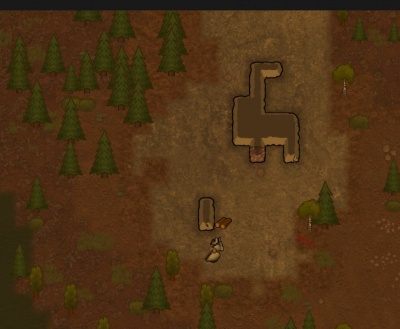
A mechanoid detoured far away from the base to smash a wooden stool.


As a small added bonus, if your outdoor bait furniture consists of a table and stool, colonists completing work tasks far from your base may stop to eat there. This may help avoid the "Ate without table" negative thought.
Mid-game defense[edit]
Perimeter wall[edit]
An additional perimeter wall surrounding all the structures and growing areas of your colony is a great defense once the colony has the time to build it. It protects from fire and either concentrate raiders into a specific area (if an entrance is open), or delay raiders and cause them to split up (if no entrance is open).
Keeping an entrance open allows the wall to act as a chokepoint - raiders will funnel through that entrance, allowing strategic placement of cover, traps, turrets, and so on. Alternatively, keeping the entrances closed will cause each raider to choose random tiles to attack, causing them to be split up and delayed. If the entrance is closed, colonists can take pot shots by entering through one doorway, firing at the split up enemies, then retreating and attacking at another direction.
Having doors placed every 15-25 tiles or so will allow colonists to fire potshots and to venture outside if needed, e.g., to haul items or to deal with breacher raids. This can be expanded (both in height/width and number of layers) whenever needed. An "airlock" with two+ doors, separated by at least 1 tile, will keep raiders and manhunters out.
Multi-layer walls[edit]
Multiple layers of wall will make it more resistant to attacks, especially against standard, non-breacher/sapper, raiders.
When making a multi-layer wall, it is often best to not have a gap in-between layers, due to how the raider AI works. If standard AI enemies have no path to a colonist and decides not to attack furniture, they will choose a random section of accessible wall and attack it, recalculating after destruction. If the walls have a gap in-between, after the first layer is broken, it is much more likely for an enemy to randomly pick the inner wall to target next, as the entirety of the inner wall is accessible. With no gap, the enemy will be unable to access most of the inner layer, meaning they will be much more likely to destroy another outer layer wall.
Having a gap between each layer of walls will make it possible to repair the outermost layer without going outside, and will make the wall somewhat better against explosions, so if not planning to completely close off the wall for combat tactics, having a gap may be better.
Chokepoints[edit]
A chokepoint is an opening in a wall or room that raiders will have to funnel through, due to there only being one open entrance. Building a colony-wide perimeter wall with one open entrance will form an effective chokepoint. From there, it is possible to concentrate firepower there, having colonists, turrets, and traps all in one place. Once the colony has enough firepower or resources, a killbox can be built at the end of the chokepoint.
- When building a hallway, turns can be used break line of sight. This will prevent long-range raiders from making potshots, although the turn itself can be used as cover. As of 1.6, placing barricades at the turn will not prevent enemies from using walls as cover.
- Turns are a great way to support melee fighters. When building hallways - both in a chokepoint and internally within your base - you may want to build turns so that melee fighters can approach without being shot it.
So long as raiders have a clear path to a colonist, no matter how long or winding it is, they will pass through a chokepoint if it is the only path. This can be used to slow raiders down, giving the colony more time to react.
Slowing tunnel[edit]

A simple and cheap tactic to slow down enemies through a chokepoint is by placing fences, sandbags, barricades, or debris in a narrow hallway, alternating them with empty space. Fences/sandbags/etc. should not be placed adjacent to each other, as otherwise they will simply vault over multiple bags at once, reducing their slowing efficiency.
Cover removal[edit]
While proper cover formations (see the Cover section above) already give colonists an advantage over raiders in terms of cover, removing all sources of cover near your base is still very useful when dealing with ranged enemies as they will then have nowhere to hide. If the base is surrounded by an all-encompassing wall, only areas near the combat zone need to be cleared.
- Haul all stone chunks towards a dump behind your defensive lines so enemies can't use them. A sniper rifle has a range of 45 tiles, though most raiders can't shoot that far, so removing chunks around 30 tiles away from your defenses can deprive many enemies of suitable cover.
- Remove the flora near combat zones, either by cutting or burning it. To prevent it from regrowing, it is possible to place roofs (supported by a single column or wall), which will also slow down raiders due to the lack of light, and the roof's support can be destroyed to cause roof collapses.
- Watch out for your crop fields, as colonists tend to move and lay out chunks in straight lines when planting on Growing zone tiles, suitable for raiders to take cover behind.
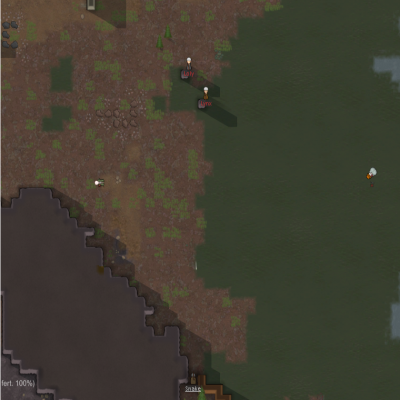
Watch where enemies choose to hide and once the battle is over plan for the future.
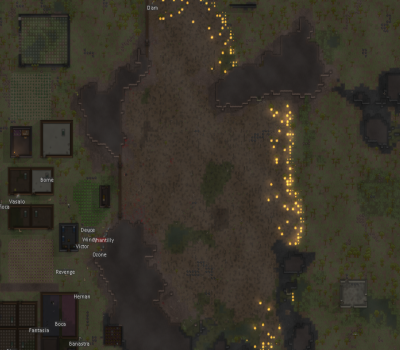
Intentional burning of a tropical rainforest to reduce any cover that raiders might use.


Cover baiting[edit]

Once there's no suitable cover nearby, ranged attackers will scramble to find any objects usable as cover. You can exploit this by placing any form of low cover to attract them to a place where they can be dealt with more easily. Stools work well, though they wear out quite fast under constant fire.
If the cover is hard to remove (such as plants and trees constantly regrowing in plant-rich biomes), you can manipulate stone chunks in ways that give them a disadvantage. For example, putting gaps between each chunk exposes the enemy behind to fire directed diagonally, or continuous lines allow missed shots to hit nearby covering enemies. If your defense line is big enough, you can bait enemies into taking cover in such a way that leaves them flanked (see picture).
You can put traps behind the bait cover, which makes it slightly easier to trigger, though still less effective than chokepoints (see above).
Pillboxes / Bunkers[edit]

A simple early game construct, effective until mid-game. Simply build a room in any shape (or convert them from ruins) and then deconstruct a few sections of wall facing the enemy to make some holes and replace with sandbags -- these will be firing holes for your shooters, where they can use the walls and sandbags for covers.
Bunkers should be built out of stone, as they are durable and are non-flammable. Roof over the enclosure to protect defenders from the rain, and floor can help improve beauty while protecting from fires.
Pros: Cheap and simple, can be placed throughout multiple locations, can be upgraded.
Cons: Generally not used with chokepoints (as regular cover is suitable for them), meaning risk of getting encircled or run down by melee attackers. If not placed well, the bunker’s utility will be greatly decreased, and not all map types suit bunkers. Enemies can use bunkers.
Pillboxes can be incorporated into perimeter walls, but make sure that there is no direct entry from there, such as by building a durable door.
Secondary cover[edit]
Besides your main line of cover, you may also build additional cover for various purposes:
- For shield distraction, building cover for your shield tanks helps them to last longer with their shields.
- Putting lines of sandbags perpendicular to your main cover line allows them to be used to flank enemies. Make sure that they are put a great distance away so enemies can't use it to their advantage.
Burning floors[edit]
You can build flammable floors to set on fire, burning enemies. Once the floors are burnt, they leave behind burnt floors that apply a 93% movement factor, and will persist until removed.
Roof trap[edit]
This clever trap is simple to set up and hard-hitting when triggered. It can be considered a giant single-use spike trap.
All you need to do is to erect 1 wall or column made of a low-HP material, optimally wood, then build a roof over it. When raiders walk near the wall, destroy it from a distance with long-range guns or by igniting an IED trap. After the wall is destroyed, the roof will fall, crushing the raiders on the head, neck or torso and dealing up to 20 damage (though armor will negate part of it). It is possible to damaging the wall before combat to make it easier to destroy, while removing the home area so colonists won't automatically repair it.
This is more of a clever use of game mechanics than an actual trap, so raiders won't detect it, nor will they treat it as one.
Pros: Large radius, cheap, penetrates shields, no risk of friendly activation. Slows down raiders.
Cons: Hard to trigger, requires space, low damage.
As a bonus, roofs can be used as firebreaks as they will prevent the growth of grass.
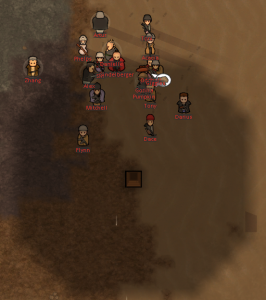
Roof trap before triggering.
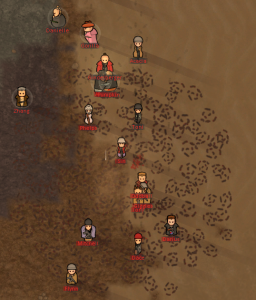
Roof trap after triggering, having injured some raiders (some through shields) and left a large pile of rubble.
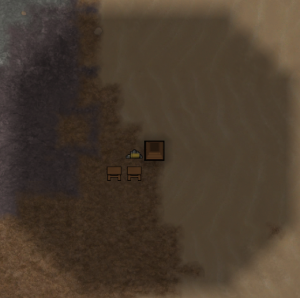
More refined roof trap design with stools to lure the enemy into using them as cover, along with an IED trap to automatically trigger the trap. Significantly more expensive.


Damage minimization[edit]
These are ways to minimize damage done to your base.

Firebreaks[edit]
2-tile wide strips of concrete, metal or stone tiles are capable of stopping the spread of fires. This can prevent many fires from reaching your base and burning it down. This is more important for plant-rich biomes with large amounts of flammable material.
You can build one surrounding your base, and divide the map into sections in order to control fires. You can also use them to separate crop fields such that a fire won't consume all your crops.
Keep in mind that building such amounts of floors usually requires huge amounts of building materials - if you have stone on hand it is better to build a perimeter wall out of stone instead, with the added advantage of fortifying defenses.
Grazing animals[edit]
Setting lots of grazing animals around the outside of the base helps clear away grass, slowing or stopping the spread of fires towards your base. They may also distract raiders during raids, but at quite a cost.
Walling structures[edit]
You should build an additional wall around your important structures, such as generators, power conduits or cash crops, even if you do have a perimeter wall in place. This causes raiders to prioritize other targets over these, averting destruction.
For geothermal generators, remember to have some exposed roof areas so the heat from the generator can vent out instead of being trapped inside.
Power network[edit]
Hidden conduits are totally immune to damage and cannot cause a short circuit, meaning the entire power grid can be secured by building using hidden conduits alone. Even one regular power conduit can cause short circuits, draining batteries and potentially disconnecting the base's power grid.
Panic room[edit]

You can dig out a panic room deep into the mountains or build one out of very thick walls. This provides a good escape if you know that you can't defeat an incoming group of raiders, or you are losing and need retreat, provided you manage to get to the room in time.
- If you dig one out of the mountains, you gain immunity against mortar shells and some innate temperature control. You will need to make many layers of doors (at least 6) as the raiders will focus down the doors.
- If you build one using thick walls you have more flexibility in its positioning, and you don't need that many layers of wall - 4 layers are OK, since raiders will divert their attention to the walls as well instead of focusing down the doors.
You don't need to make the panic room big enough to accommodate the whole colony, as the point of a panic room is to preserve colonists in a dire situation so you can rebuild later on. Choose the colonists most important to you when it's time to escape to these rooms.
Panic rooms also need the following:
- Enough food to last 1-2 days at full capacity
- Medicine for the wounded, for injury is likely during the retreat
- Joy objects (otherwise colonists may face a huge -20 mood penalty)
If you want, you can put beds and tables to make sure your colonists don't feel too bad while cooped up inside. You can also choose to put building materials to seal up the entrance with cheaper and more durable walls. Putting resources inside also helps with rebuilding, though they take up space.
While inside the room, if you're down on your last door or layer of wall, assign your best builder to hold the door by repairing it, and make sure the others don't go out. Disabling firefighting for covering colonists or restricting them to the panic room can help stop them from leaving. If the doors are unable to hold, use the breach as a chokepoint instead, and take as many enemies down with you.
Consider building multiple panic rooms so your colonists have another panic room within reach if a raid blocks off access to one. You can also choose to build another exit so you can flee to another room should the original be overrun.
Mid-late game defense[edit]
Turrets[edit]
Turrets are automated defenses which shoot at enemies in range but require materials to reload. There are three main varieties: the mini-turret, autocannon turret, and uranium slug turret. There are also two unconventional turrets, including rocketswarm launchers and foam turrets.
Turrets should not be relied solely upon for defense. A perimeter wall of turrets will not remain viable for too long, as the turrets will quickly get overwhelmed while not all the turrets are actively helping combat. While turrets are more effective in killboxes, certain raid strategies like drop pod, breacher, and sapper will ignore the killbox, so preparing defenses and gearing colonists is important. In addition, a solar flare will shut down all turrets.
While protecting the outside starting area, you may want to rapidly pause the game during raids and give orders to repair damaged turrets.
Remember that turrets may explode when critically damaged, so get your colonists to run from them.

Green is 80 - 100% of peak accuracy, blue is 50 - 80% of peak accuracy, red is below 50% of peak accuracy and grey is outside range. Gold tiles are spaced every 5 tiles.
Mini-turret[edit]
Mini-turrets fire light bullets at enemies within its range.
With its low firepower it is not a good idea to extensively rely on them, especially in mid-late game. However they do provide decent additional fire to lay on the enemy when combined with gunners, and also serve as a distraction from your more valuable colonists.
Pros
- Can be uninstalled and re-deployed wherever needed, making their placement slightly less of an issue
- No exclusion zone allows them to fire at touch range
- 1x1 size makes it harder to hit and more compact
Cons
- Inaccurate at long-range
Building turrets out of plasteel brings their health to 335 (up from 120), making them substantially more durable and slightly less flammable.
Autocannon turret[edit]
Autocannons deal moderate damage and are long-ranged, but have an exclusion zone making them less effective against close enemies in the frontline.
They are somewhat costly to build and maintain. Despite its long maximum range, it is mainly effective at short-medium ranges due to its accuracy.
Pros
- Shots deal decent damage
- Somewhat high fire rate
Cons
- Inaccurate at long-range
- Somewhat high cost per shot
Uranium slug turret[edit]
A long-range turret that fires a high powered uranium slug.
It is more accurate than the other turrets at long distances and has much longer range, but is more expensive to maintain and performs poorly at close range.
Pros
- High damage shots
- Extremely high armor penetration, able to negate most all armor on an enemy
- Accurate at long ranges
Cons
- High cost per shot
- Not good at close ranges
Rocketswarm launcher[edit]
Rocketswarm launchers must be manually controlled, and fire one barrage of rockets before needing to be reloaded.
Pros
- Wide AOE.
- Cheaper than autocannons, and reloads using chemfuel instead of metal.
Cons
- Requires a colonist to aim it.
- Rockets will destroy structures, meaning the base needs to be designed with rockets in mind.
- Not very effective unless enemies are clumped up. Having enemies clumped up is bad for other types of defenses.
Weaknesses[edit]
Turrets are most vulnerable to the following things:
- Explosives deal immense damage to turrets. All forms of regular explosives wielded by raiders are capable of 1-hitting a steel mini-turret and leaving a plasteel one at less than half health.
- EMP stuns the turrets. Enemy EMP is very uncommon, but friendly fire can disable turrets.
- Smokepop packs prevent turrets from locking onto targets within or behind smoke. An enemy equipped with it can create a safe zone from turret harm.
- This is a great issue in killboxes, where turret firepower is often concentrated, as an enemy that activates the belt will essentially be able to nullify a large portion of your defensive firepower.
Turrets can be ignited, and are unable to put themselves out. Given enough time, flames can debilitate the turret.
For the mini-turret, long-ranged gunners can shoot from outside their range without retaliation from the turret. This includes lancers with their Charge lance, making them less than ideal for fighting off Mechanoid incursions.
Turret placement[edit]
- Placing turrets in a chokepoint and/or killbox is effective, allowing all the turrets to be concentrated into one area instead of having them be spread out. Placing more than 1 line will allow the colonists to fall back in case raiders advance too far.
- Turrets can benefit from cover, so placing barricades or sandbags in front of the turret will improve its performance.
- Since melee enemies will try to attack turrets, placing traps in front of them is a great way to protect the turret further.
- Turrets will explode, so place turrets at least 3 tiles apart from each other to avoid a chain reaction.
On-demand turret deployment[edit]
For mini-turrets, instead of placing static turrets around the perimeter, you can instead keep them uninstalled and placed in the center of your base. Once raiders come, have a builder install them facing the battlefield, behind your cover. This helps to save power and also allows you to utilize turrets more efficiently as you can keep more turrets engaged on the enemy rather than just sitting there due to lack of contact with the enemy.
This tactic is less effective against melee charges who will swarm your defenders before you have enough time to react.
Turret power switch[edit]
Turrets should be turned off whenever not in use. Turrets can be turned on/off quickly by installing a power switch that connects all your turrets to the main power grid.
Alternatively, it is possible to build a single unconnected hidden conduit near the turrets. By using the reconnect gizmo, the turrets will switch from the unconnected "grid" to the main grid, taking no time in the process.
Mortars[edit]
A mortar attack can be effective at forcing sieges to start attacking directly, culling raiders as they prepare, and dealing with crashed ship parts and mech clusters . However, mortars are fairly inaccurate, so multiple mortars are often needed to be effective, and their long travel time means hitting moving raiders is difficult. Skilled colonists are more accurate with mortars, but unskilled colonists can still provide supportive fire and they can be effective with large-radius shells like EMP shells and smoke shells.
Always remember to manually unassign colonists from mortars, or they'll continue standing there until they eventually collapse from exhaustion, starvation, or have a mental break.
An important point to remember is that while your colonists are better at dealing with single or spread-out enemies, mortars are designed for heavily grouped enemies. If you diffuse your enemies, the mortars will not be able to hit the enemies easily.
Don't aim mortars anywhere too close to your colonists otherwise you risk friendly fire.
Mortar pits[edit]

Mortars cannot be fired through a roof, but they can still be placed indoors for security and colonist happiness. Note that mortars will explode if damaged enough, which, while rare, can happen due to enemy mortar shells. Separating each mortar, as well as the mortar shells, with high HP walls will prevent a chain reaction from destroying the entire mortar pit. Building mortars with plasteel, uranium, or bioferrite will give mortars high enough HP to survive multiple explosions.
Mortars can't fire at anything within 30 tiles of it, so you will need to place the mortars deep inside your base for maximum coverage.
Keep in mind that your landing mortar shells will blow up anything nearby, including pawns and things of yours that raiders don't commonly target
Quantity[edit]
The number of mortars needed depends on how they will be used:
- For provoking sieges, one mortar firing incendiary shells is often enough so long as fire is allowed to spread. It is also possible to get away with using one mortar firing high-explosive shells with a great shooter.
- For stunning mechanoids with EMP shells, multiple mortars are needed, especially against mech clusters with mech high-shields (which require 1 EMP + multiple regular mortars at minimum).
- For damaging general raids with high-explosive shells, even more mortars are required.
Shells[edit]
There are different shells available to be loaded into the mortar.
- High-explosive shells are the go-to ammo for dealing damage to enemies and buildings.
- Incendiary shells deal weak damage against pawns, but they can cause an enemy siege's own mortar shells to explode, causing the siege to start attacking directly.
- EMP shells stun mechs and break shields, making them useful but highly situational. They have a large blast radius, meaning that their inaccuracy is less of a problem compared to the others. Their ability to break mech high-shields is particularly useful.
- Smoke shells will block turrets from locking on and reduce enemy fire, but a smoke launcher or smokepop pack are typically better for this role.
- Firefoam shells can be used to extinguish fires outside your base, but is useless against any inside, due to the mortar's blind spot.
- Deadlife shells revive nearby corpses as shamblers. More useful as an IED trap than as a shell, as it is unlikely that corpses will pile up in the area raiders arrive in.
Traps[edit]
As you unlock research, and obtain more manpower and resources, you can lay more traps to debilitate incoming raiders.
Understanding AI[edit]
Raiders cannot use the colony's doors, cannot see traps, and will traverse through the quickest unobstructed path to a colonist. Colonists can step on traps if walking over their tile, but can see traps and will take slower routes or doors to avoid them.
Building doors and fences to give colonists a quicker path, as with a spike trap tunnel, will allow colonists to travel while funneling enemies into a single chokepoint.
IED traps[edit]
Early on, you may want to focus on armed colonist defense with turrets, but as the raiders grow in number, it becomes more efficient to use a bit of metal to kill several at once than to invest a lot of metal in a turret that costs nothing to fire, but will explode rapidly due to large raider groups.
IED traps are extremely effective when used correctly, however in open areas they are mostly useless as the raiders are highly unlikely to step on any of the traps, and even if they do they're usually not tightly packed enough for the trap to cause serious damage. Thus, it is better if you combine traps with funneling to force the raiders together.
1 IED trap can trigger other IED traps in its explosion radius. This may or may not be desirable depending on the situation; you can easily set off a chain reaction to destroy a whole incoming raider horde, but also use up much more resources. They also damage nearby structures, such as walls or spike traps, so don't put too many close to each other.
- Rather than setting more IED traps near existing ones, you can just place the Mortar shells themselves, or even some Chemfuel on the ground for the same effect as a molotov cocktail blast. However, unless you can restrict them to placing just 1 of each it's more expensive to do so.
- Chemfuel has 50 HP, just within the damage threshold of an IED trap, but the shells have 70, so you will need to pre-damage them or leave them on the ground to deteriorate first if you want to use this tactic.
IED traps have a delay before exploding, allowing some raiders to escape. Raiders will attempt to run from an exploding trap, though the fuse is short enough to catch some of them.
Pros
- High area damage
- Raiders usually less protected against explosives
Cons
- High resource cost
- Single-use, non-rearmable
- Requires research
- Does not instantly trigger
IED incendiary traps[edit]
A variant of the IED trap that sets enemies on fire. It's a more situational pick compared to the regular trap, due to its incendiary nature.
Pros
- Distracts enemies while they are on fire
- Penetrates shields
Cons
- Low damage
- Not effective against Mechanoids
Its use requires strong support to be effective. With that, it is a good defensive choice against heavily armored or shielded enemies, with the flames providing good distraction while your colonists shoot them down.
It synergizes great with brawlers, which will prevent the enemy from attempting to extinguish the flames while fighting.
IED EMP traps[edit]
A variant of the IED trap that creates an EMP pulse. It's a more situational pick compared to the regular trap, due to its EMP explosion.
Pros
- Instantly downs shields
- Stuns mechanoids for a long time
- Large blast radius
Cons
- No physical damage
Its use requires strong support to be effective as it can't deal any damage. It is excellent against mechanoids or shielded enemies, however.
Mountain trap[edit]
An extreme version of the roof trap using overhead mountains instead of constructed roofs.
To use it, you mine out a whole mountain except a pillar in the center. Then you damage that pillar until it has just a sliver of health left (25 or less for easy activation with a single sniper rifle shot). Mining out all the rocks at once will result in your colonists getting crushed by the trap.
It is triggered the same way as the regular roof trap, and has the same effect radius except victims are instantly killed and buried. The collapsed rocks spawned after this trap is triggered can be useful or harmful depending on the situation.
Rearming it is a lengthy process as you will have to mine out lots of rocks. This does provide a decent way to train miners though.
Pros
- Instantly kills any enemy
- Leaves no corpses
Cons
- Takes much longer and is more dangerous to re-arm
- You have to mine out everything then support the mountain roof with a low-HP wall; compare with regular roof trap which simply requires building the wall and the roofs
- Colonists risk death if you aren't careful
- No loot or capturable downed raiders
- Overhead mountains may not be easily available
In mountainous areas where overhead mountains are abundant, this trap can absolutely destroy any incoming raids, especially when combined with funneling.
Reactive firefoam poppers[edit]
You should have some uninstalled firefoam poppers on hand. When a fire starts and you need to extinguish or control it, you can reinstall them near the fire, and trigger them.
Firefoam on the ground slows movement speed of pawns by about 25%. As it covers a wide area, this can be slightly useful as area denial to slow down charging melee attackers, though it prevents the use of fire against them.
Firefoam roof array[edit]
Due to the slight slowing effect of firefoam, you can deploy a large amount of it to slow down enemies crossing by. However, since rain washes it away, you need to erect a roof to prevent that from happening. You also need to clear home area so colonists leave the firefoam alone.
This has the added effect of creating an excellent firebreak against wildfires, as well as creating a roof trap that can damage enemies.
Initial deployment of the firefoam is very expensive without the use of chokepoints so it isn't recommended for open base designs.
Killboxes[edit]

Killboxes are heavily trapped, armed areas where enemies are funneled into so they can be destroyed easily.
They almost always consist of a funnel which directs raiders into it, like a wall with a single opening, which opens into a zone where your colonists and turrets are located.
Raiders will then trickle in, allowing colonists or turrets to concentrate fire on them, or traps to destroy them while they try to move in to attack. In the killzone, enemies lack cover and are within close range, while your colonists have plenty of cover to fight from.
This is an extremely effective way to defeat most raids, as the enemies will often be overwhelmed by the sheer firepower raining on them. It also allows effective use of traps, as funneling enemies greatly increases the chance one's going to trigger them. A well-built killbox can easily neutralize the threat of many raids, which may make the game less fun for some players.
Note that killboxes aren't a catch-all solution to enemy threats, and you still need tactics to handle drop pod raiders or sappers.
Building[edit]
The entryways should lead to a large 'box' where the killing begins (hence 'killbox'). The box should be surrounded by cover sources (preferably walls plus sandbags) where your colonists fire on the enemy. For increased firepower you may build turrets as well, away from your colonists' firing line and separated from each other by walls, in case they explode.
It's always best to double-wall the "receiving" end of your killboxes as the sheer firepower raining on your enemies will inevitably destroy some of your own walls by accident, allowing raiders to flood in from another direction, bypassing traps and overwhelming your defenders. This is especially true if you use explosives such as frag grenades or IED traps to kill incoming enemies.
Entryways[edit]
Any entryways of the killbox should not be straight, otherwise raiders will simply fire using the entryway as cover. Instead, you should have a turn to break line of sight, prompting the raiders to enter an area where you can get them easily. For better effect, put a grave or other similar object that raiders can't stand on. The entryway should be single wide to allow the use of melee blocking if necessary.
The below shows the results of different killbox entryways.
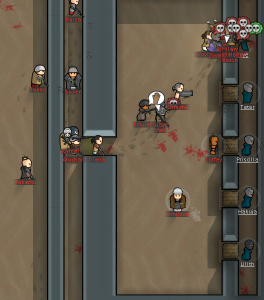
Right design of a killbox entryway. Raiders are prompted to move into the killbox, sometimes so close that they prefer to melee attack instead of shoot.
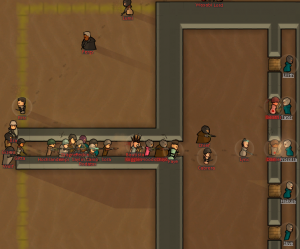
Wrong design of a killbox entryway. Raiders are bunching up in the entryway, using its walls as cover.


Entryways should be long, but not too long, corridors with fences every second tile to slow enemies. Do not place a continuous line of fences, as pawns only slow down when they are vaulting over one. In between the spaces, spike traps can be placed to soften up the raiders (with doors adjacent to the fences so your colonists can replace them). At the end of the corridor, place a T-Shaped fence line (do not alternate with empty tiles like before), as pawns cannot stand on the sandbags and therefore are incapable of using the corridor exit walls as cover. IED traps can be used, but should be used sparingly lest they blow up all the walls of the corridor.
Don't make your entryway excessively long, otherwise raiders will think it's not worth it going such a distance and will decide to go for something else instead. Manhunters however will still chase colonists down a long corridor or over extreme distances, so you can have some dedicated anti-manhunter killboxes with extra-long corridors for this purpose.
If your entryway is long then you may need to build doors to allow friendlies to enter without setting off your own traps or having to go through all the obstacles. This door obviously needs to be fortified against enemy attacks.
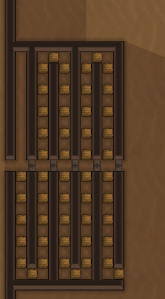
Entryway with alternating sandbags to slow raiders and doors to provide access. Slows raiders but not colonists.

Equipment[edit]
Different equipment is necessary in different situations.
Short-range killboxes[edit]
Colonists defending in a short-range killbox will be shooting at a large number of targets no more than a few tiles away. Thus, defenders should use close ranged high damage weaponry for firing at raiders.
- Chain shotguns inflict extreme pain at killbox range, surpassing the DPS of every other weapon at short range or less.
- Miniguns are excellent at attacking the bunched-up raiders inside a killbox, but require large amounts of resources to craft (
 160 Steel,
  20 Components).
 - Charge rifles and heavy SMGs are second-tier picks, being able to dish out hurt against closely grouped targets at close-mid ranges.
- Long range weapons are not optimal due to low DPS. Instead, use them to pick off survivors outside the killbox.
- Grenades are good if you can time them right. Throw them near the entrance where each explosion can hit a tight group of raiders, especially if they're slowed down with obstacles, but take care not to demolish your own walls.
- Have melee colonists stand nearby as raiders who enter your killbox may decide to melee charge you instead.
Long-range killboxes[edit]
Colonists defending in long-range killboxes will be shooting at bunched up raiders. Thus, defenders should use mid-range, fast firing, and decently accurate weapons to inflict as much damage as possible. Note: It is possible to modify a killbox in a pattern that leverages both long and short range weapons. This can be accomplished by creating a passage that has a 45 degree angle "open to the field" while keeping the main 90 degree passage open to short range fire only.
- Charge rifles are the best weapon[Arguable] for this purpose, shooting 3 semi-accurate high damage charge shots. It also has a decent 26 tile range and an excellent 35 percent armor penetration, essential for killing targets late game, when your killbox is more developed.
- Heavy SMGs are excellent alternatives to charge rifles. Significantly cheaper but similarly skill friendly and with a solid DPS.
- Assault rifles are basically charge rifles with lower damage and armor penetration, but making it up for its longer range and higher accuracy. Higher skilled pawns are required to make use of their range however.
- Miniguns, Chain shotguns, and perhaps LMGs are second options, excelling at crowd control, especially against tribals.
- Explosive weapons are not advised, as raiders will be moving around the killbox frequently, and grenades have a delay between the grenade hitting the ground and the explosion of the grenade.
Turrets[edit]
You can put turrets in a killbox. They help to provide additional firepower alongside your colonists.
You may also choose to fully arm your killbox with turrets, with enough to single-handedly take out raids especially in tandem with traps. Doing this allows you to defeat raids automatically without the need to divert colonists from other jobs, but eats up power when active and resources to maintain, and is vulnerable to solar flares, EMP grenadiers or smoke, so you will need backup.
Turrets should preferably have their own cover. They should also be connected to a separate grid which can be shut off to deactivate them all, to save power when not active.
Mini-turrets and autocannons are the best choices for killboxes, being able to dish out hurt at killbox ranges. Place mini-turrets close up to the enemy, while place autocannons slightly farther away to keep enemies out of its minimum range.
Alternatively, if you can keep the enemy in one spot, a specially designed killbox can allow uranium slug turrets to function well. Uranium slug turrets are most accurate at 40 tiles or above, achieving a maximum of ~61% accuracy against human enemies, so you will need to place them that far from the entrance, and distract enemies so they do not go closer. Slug turrets are good against tankier pawns, as a uranium slug can easily rip through Centipede and Power armor.
It is better to 'Hold fire' until the enemies have actually entered the killbox, for all the turrets will focus fire on the first enemy to try and go through the entrance, which is very much overkill.
Blocking[edit]
As melee blocking is more effective than even a killbox used normally against melee only attacks, it's best to have somewhere that you can do this.
Melee blocking can be done at killbox entrances, as long as it is one-tile wide and has sufficient empty space in front. Both the entrance to the killing area and the entrance to the covered area where colonists fire onto enemies will work:
- Doing it in the killing area allows you to spare the turrets from immediate destruction, and they may add firepower.
- Doing it in the covered area entrance allows you to sustain fewer injuries by having the turrets take the damage first.
Explosive weapons[edit]
Enemies carrying explosive weapons can be very damaging towards your killbox and the defenders inside.
Centipedes with inferno cannons can counter killboxes as the fire makes your colonists lose control and run out of cover, and the flames can destroy turrets easily. Having some firefoam poppers inside your box helps a lot with extinguishing fires and preventing future fires.
Another counter for killboxes are raiders with the triple rocket launcher and doomsday rocket launcher. If they manage to shoot inside your box the damage can be massive, and it is hard to distract them in a killbox. You can concentrate fire from your colonists on them, or keep psychic shock lances and psychic insanity lances near and use them if you see that they will not die fast enough.
Fire killbox[edit]
Besides killing enemies with conventional weapons, roasting them with fire is also an effective choice. You need to lure them inside, light up flammable objects to heat up the killbox, and evacuate colonists so they don't get roasted as well.
Fire killboxes are slightly more complicated to operate than a regular one, where you can simply wait inside and fire; you will need to direct colonists, while others light up fires and then make a break for it.
You can shut off the killbox by either leaving doors open to let enemies in, which you then shut off by disabling "keep open", then directing a colonist through them, or by building walls.
They need to be at least walled to prevent enemies from breaking out, and also to insulate it from the outside so that temperatures rise faster. Stone walls are optimal as they are non-flammable.
Killhall[edit]
|
This section is suggested to be rewritten. Reason: Largely similar to killboxes, should be merged with that section. You can help the RimWorld Wiki by improving it. |
Another possibility is to build a long corridor with traps, that can also be used shoot enemies from cover: a "killhall".
It acts as an active and passive defense:
- If used actively, it allows to kill enemies will little to no harm done to colonists, and with little damage to repair after the attack.
- If used passively, it'll lure enemies into spike traps. Only very large or tough groups of enemies may go through (by springing all the traps), or possibly enemies with the "nimble" trait (that will avoid all of them).
If the first part has many obstacles (e.g. stone chunks, barricades or sandbags), and another branch of the corridor is empty and ended with a flimsy door (e.g. a wooden door, or better: an animal flap), fleeing enemies will try to escape by this seemingly faster exit, but they will fall into another group of spike traps, eliminating the rest of the raid.
A drawback is that last part of the corridor has to be quite long to work properly, i.e. a bit more than the range of the weapons used (e.g. 30 tiles for assault rifles and charge lances, 45 for sniper rifles). This is not an issue if it is placed under a mountain, the best location being at the corner of the map.
Attack of a killhall[edit]
An attack will proceed as follows:
- Enemies will be lured into the hall, thinking it is an unobstructed way into the base.
- They are slowed by obstacles, leaving time for colonists to take position inside doors, hidden behind wall corners, waiting for them.
- Enemies are shot one by one by colonists, they are slowed by stone chunks and cannot rush in for a melee attack before they get shot. Enemies who shoot behind their friends others can sometimes hit them by mistake.
- Once half of them are dead, they decide to flee, but instead of going back by the way they used to enter, that looks cluttered by chunks, they try to break the doors on the side of the corridor.
- They are still shot at by colonists, but once they broke a door, it seems that there is only a flimsy animal flap between them and liberty.
- Unfortunately, what seems to be an exit path is littered with spike traps and they get killed one by one by them.
- If some of them still manage not to get killed by the traps, they get shot like clay pigeons in the exit corridor.
- It is now time for the colonists to strip the dead enemies of their possessions and store their corpses for later use...
If colonists decide not to attack the invaders, half of them will be killed by the traps on the entrance way, the other half on the exit way. If the attackers are manhunting animals or mechanoids, they will not try to escape and will all be shot or being trapped.
Example of a practical implementation[edit]

- Entrance and "escape exit".
- The entrance has a door "held open" and "forbidden", so enemies can enter, but not friendlies.
- The "escape exit" has an animal flap (can be substituted by a wooden door), leading fleeing enemies to think that they can break it to escape quicker.
- "Slowing down" corridor, filled with stone chunks spaced one tile apart that will slow down enemies, give time to prepare and make this path look like a slower way to escape.
- "Shooting range" corridor, where enemies will be shot at from distance and will be forced to advance one behind another. It is also filled with stone chunks to slow them while they're being shot at (as chunks may be moved or destroyed during the attack, 1×1 stockpile zones allowing only stone chunks should be placed, enabling their quick rearrangement).
- Above, the "escape exit" corridor, filled with spike traps (doors allow replacing traps without having to walk on them).
- Below, the "entrance to the base", also filled with traps.
- Part of the hall where colonists will shoot, taking cover with the wall corners. If the enemy has weapons with more range than colonists, they can hide behind the doors and pop out when the enemy is close enough.
- "Entrance to the base" (or at the part that enemies are planning to reach), with wall corners at the end to use as shooting positions (in case some enemies reach this part).
- Human corpses walk-in fridge, to put the bodies after the battle and keep them away from the view of colonists, avoiding the "observed corpse" debuff.
- It should be quite large, as enemy raids grow in size, and butchering humans should not be done every day, to avoid a permanent I\we butchered humanlike debuff (see the possible mitigation strategies). It can also hold the human leather stock, as it takes much space once butchering is done.
- This can also be a place where corpses are burned, if it is preferred to butchering.
- Human kibble factory, where human meat can be processed into kibble (that extends hugely its conservation time, can be sold, or fed to any animal).
- Repair stock, that holds the necessary materials to quickly repair the walls and the spike traps after an attack.
- Hospital for prisoners, to quickly save them if they survive.
Points 6 to 9 are optional, but are great improvements if used.
Additional notes[edit]
- Walls of the parts 3 and 4 should be tough and fireproof. Best would be plasteel, then uranium; granite blocks may also be used but will break down faster, and flammable materials are to avoid at all costs.
- Flooring should be put in place to keep the mood of the colonists high when they are in the area.
- Walls and flooring of the parts 2 and 5 doesn't matter, as colonists will very rarely go there, and there shouldn't be much fighting in these parts anyway.
- Spike traps should be made out of steel, as it has the best price-quality ratio for this device (nevertheless, steel is flammable in RimWorld, but here, traps are protected behind the walls and doors).
- Accurate weapons should be preferred for colonists: the narrow corridor will be damaged unnecessarily if explosives are used, or weapons like shotguns or miniguns (not to speak of their reduced range).
- The hall should like an unobstructed path to enter the colony (i.e. no closed door between the outside and the inside of it), but the doors leading to it that will be used by colonists should be strong enough to deter attackers from trying to break them.
- The number of stone chunks in the way is also important: if there are not enough of them, fleeing enemies will just escape by the way they attacked and will not be led into the spike traps on the supposedly quicker escape route.
Situational[edit]
Crashed ships[edit]
It is vital to know Mechanoids' behavior:
- Any attack to the ship will trigger its guardians, and they have a long aggro range of around 40 tiles from their spawn point. The larger the map, the easier it can be to deal with them, as long as the ship crashes away from your base. This means that as long as they are far from your base, Mechanoids will still NOT chase you yet.
- When the ship's health falls below 50%, Mechanoids will stop guarding and will instead proceed to attack your base as a normal raid.
You can trigger a ship's guardians from a long distance either by bombarding with mortars or hit-and-run with sniper rifles.
Currently, the best approach is to deal with the Scythers first, followed by their ranged units. There are a variety of alternatives, but the nature remains the same; hinder the melee range closing-in of their shock troops.
Preparation[edit]
Though these ships are "time bombs", instead of immediate action, you can spend a few days building preparations before engaging them.
- Placing a spike trap right in front of your sandbag may be helpful if the need to retreat arises, as mechanoids will very likely want to use the shortcut.
- Always make sure you have a safe path between your walls and your base, so that there's safe cover between your "ins" and "outs"; battles can take a long time if short on numbers.
Building IED traps can also be a good way to hurt the mechanoids, especially if there is a long distance between your colonists and the ship part. High-explosive traps deal hefty damage to incoming scythers and lancers, while EMP traps stun them, making them vulnerable to attack.
If possible, a properly placed antigrain IED trap can obliterate most of the mechanoids, leaving a few heavily damaged centipedes to fight at most.
You may also want to keep a few firefoam poppers nearby. Trigger some of them before combat to prevent fires, and leave a few more to rapidly extinguish a group of burning colonists at once.
After you have finished preparing, you can use EMP shells to stun the mechanoids. Proper firing will make them helpless hunks of metal, once you get used to this technique, you can even preemptively fire EMP shells and then trigger the guardians, so as soon as they pop out, they instantly get hit by EMP shells. The number of manned mortars will factor in, as the chance to miss for each shell is quite large.
Cover[edit]
Use the "fire wall" cover approach detailed above, with melee units stationed behind each sandbag to hold off the scythers while your gunners lay fire on other mechanoids.
Ideally, the cover should be placed a distance from the ship, giving you time to soften incoming scythers with concentrated fire.
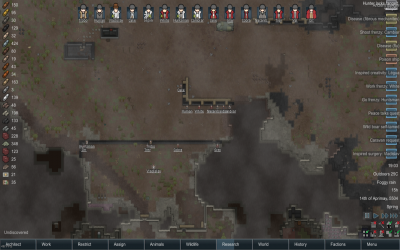
Zoom out
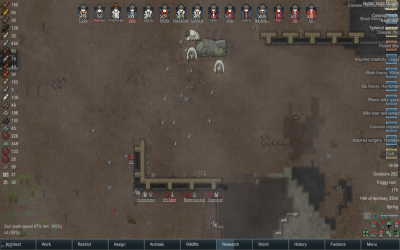
Zoom in


However, if you already have all the necessary utilities against mechs: EMP grenades and a good killbox, you may just wall the ship part off, (be aware that mechs will wake up if you build things up close to 2 cells to a sleeping mech, it's 5x5 square radius around any mechanoid) add one-two doors, you may want to add 2 walls deep mini corridor, so random fire from mechs won't hit the door, and a single barricade next to the door, draft your pawns to the entrance, force one to open it, while the door is opened (it must be made of wood) the other pawns will shoot the ship, mechs shouldn't have enough time to aim, the door will close pretty quick (do NOT hold it open), use "Heavy smgs" or other high dps and fast shooting guns, you can also equip frag grenades, a single colonist with grenades is enough, one is throwing it at the ship, while the other one keeps opening the door. As soon as you destroyed the ship just run, the mechs will be smashing the walls and head for your killbox.

'The Purifier'[edit]
This is a powerful way to burn a massive infestation to a crisp. Provided that the infestation have no direct access to map edges and unroofed areas.
To start, build a medium-sized room (approx. 5x5) with triple-thick stone walls, next to the infestation. Fill it with Straw mattings, and flammable objects such as wooden barricades, it has good hp which means it will burn for longer and has high flammability, so it will catch fire quickly. Another alternative is to use combustible junk, like tainted clothing or unneeded corpses.
After that, dig a 1-wide tunnel towards the infestation at night when the insects are sleeping. Finally, toss a Molotov into the room.
Once the temperatures reach (250 °C (482 °F)), insects will begin to burn. They will attempt to dig out by rushing towards the purifier, but be set alight by the burning Straw matting, making them unable to dig. Temperatures can rapidly reach 500 °C (932 °F) or above, boiling both the insects and the hives. Even those that don't get set alight will eventually succumb to heatstroke.
Although using this method will not yield you valuable insect jelly.
- Progression
- Quickstart Guides • Basics • Intermediate Midgame Guide • Advanced Endgame Guide • Ending the game
- Scenarios
- Lost Tribe Guide • Rich Explorer Guide • Naked Brutality Guide • The Mechanitor Guide
 • The Sanguophage Guide • The Odyssey Guide
 - Survival
- Extreme Heat Guide • Extreme Cold Guide • Extreme Desert Guide • Ice Sheet Guide • Sea Ice Guide • Events Guide
- Combat
- Defense tactics • Offense tactics • Weapon Guide
- Construction
- Colony Building Guide • Defense structures
- Production
- Food production • Money making guide

- Security
- Barricade • Sandbags • Spike trap
- (research)
- Autocannon turret • Foam turret • Mini-turret • Rocketswarm launcher • Uranium slug turret • Mortar • Hunter trap
- IEDs
- IED trap • IED incendiary trap • IED EMP trap • IED firefoam trap • IED smoke trap • IED antigrain warhead trap • IED tox trap • IED deadlife trap
- Related
- Antigrain warhead • EMP shell • Firefoam shell • High-explosive shell • Incendiary shell • Smoke shell • Tox shell • Deadlife shell