Intermediate Midgame Guide
 |
This article is suggested to be rewritten. Reason: Outdated/incorrect in many places. Needs full fact checking, updating, and reverification. Also suggest: Replace some sections with links to the more specific guides than rehash existing guide content. E.g. Weapons, Cash crop, Combat & defense tactics etc.. You can help the RimWorld Wiki by improving it. |
"Mid-game" is the phase of an established colony after the basics of food, temperature, and defense are stable, and the colony is progressing towards an ending. At this point, you want to create a stable community that is self-sufficient and can recover from disaster as quickly as possible. Even a string of bad events should not lead to ruin.
This is the longest phase of a typical playthrough. The most important challenges are to keep up with enemy raiders and to have everybody in a good mood. The game tries to put your colonists in a bad mood in many ways. Counteracting this is how you avoid crises and increase overall productivity. A lot of the advice in this guide revolves around mood management, either directly or indirectly.
Buildings and Infrastructure[edit]
Here is a list of facilities in rough order of importance that an established base in midgame should have – these will vary heavily based on difficulty and map conditions (but you will know when your defense was too weak for your difficulty level...).
- Power supply: the power supply must be sufficient to run all essential facilities, including lighting. Since power is critical in some areas (e.g. to run the freezer) it must not be easily interrupted by damage, so hidden conduits are ideal.
- Kitchen: a place to prepare food. This is critical to any colony; the kitchen must be well maintained and in an accessible place.
- Food production: some capacity to farm vegetables (e.g. an outdoor farm with some protection from fire and animals, or an indoor facility). How much is needed depends on the amount of meat available from hunting, and if you have domesticated animals yielding products. You also want to farm medication and various drugs, in addition to food.
- Warehouse: a storage area that is reasonably fire-proof and easily accessible.
- Living: good living conditions for your colonists. This usually means private bedrooms for everybody, and all colonists with special needs ("greedy", "jealous") covered, as well as a dining and recreation area. All of this should be as comfortable and beautiful as possible.
- Hospital: at least a few beds in a clean room to tend patients. Preferably the room should be sterile and include hospital beds and vitals monitors. A stockpile of medication should be in this room.
- Defenses: weapons and facilities adequate for your difficulty level to defend you from raids. This can range from a few walls to heavy fortifications and automated turrets.
- Production: a dedicated area for crafting and creating. This should be close to the warehouse, and made as comfortable and beautiful as is reasonable.
- Laboratory: a dedicated area for research, which, like production, receives a penalty for not being in a dedicated room.
- Freezer: a refrigerated room that is large enough to hold enough fresh food to get you through the winter or special circumstances like a toxic fallout event. How much food you need to store depends on a lot of other factors.
- Prison: if you get a lot of "visitors", some decent accommodation (a.k.a. brig) is in order. The prison cells should be comfortable enough to keep the prisoner as happy as possible, because that makes recruiting them easier. Consider creating extremely small and uncomfortable cells for prisoners who you would like to Convert to your Ideoligion, because pawns with low mood lose Will and Certainty faster.
- Prison: Alternatively, you can use prisons as an experience farm by making it so the guests revolt as often as possible. Stack those mood debuffs to the point where they have mental breaks while in catharsis from the last one to get Medical, Combat, Social (via Wardening) and Construction experience in much higher amounts than you would with a "nice" prison since your guests stay much longer before you can break their will, then recruit or release them.
In general:
- All areas should be well lit (no dark places).
- Frequented areas should have constructed or smoothed floors.
- Autodoors should be used in frequently trafficked places (the kitchen, freezer, storage and production room).
Do not strive for perfection in any of these areas yet. It is better to have a makeshift hospital than none at all; so make a room with a few beds that are only used for medical purposes, before thinking about hospital beds and sterile tiles. The important point is to have medical beds on stand-by, in a clean room, at all times – not to have the perfect end-game hospital right from the start. Likewise, keeping a small, ugly, insecure prison barracks is still better than having to re-purpose rooms after every raid in order to even capture somebody (leaving some colonists without bedrooms in the process).
Create the basic facilities first, then improve them afterwards. Do not take unnecessary shortcuts (for example, do not put the butcher's table in the medical room, because "there just was no better spot at the moment"). By the midgame you should strive to have everything built out of stone.
The kitchen, hospital and laboratory (research benches) can be placed in the same room, which should be sterile. This is because room cleanliness has a major impact on cooking, medical outcomes and research speed. Moreover, both the kitchen and hospital benefit from being in a central location, and the mood impact from waking up a pawn during treatment is pretty minor compared to the impact of acute pain.
Make all rooms as cozy and beautiful as possible, especially the areas where your colonists spend a lot of time: research desks, workshops, and recreation rooms. A beautiful environment will lift up their mood; build beautiful objects anywhere your colonists spend a lot of time, not simply the recreation area. Putting good chairs in front of all production desks will make your colonists feel comfortable while they are using them.
Rooms and corridors must be spacious enough to not cause problems and allow your colonists to move around freely. Leaving a little extra room is almost always a good idea. While one-tile corridors to infrequently used locations are fine, you will probably want at least two tiles for the major travel paths.
Freezer[edit]


Freezers are a convienent facility, and are practically essential for storing corpses, meat and already prepared meals. However, they are not strictly necessary. Most crop foods last for 40 days unrefrigerated, which is easily long enough to last a full toxic fallout or volcanic winter and wait for rice to grow again. In cold biomes, it may be needed to store food for longer than 40 days, but the natural tempreature will be enough to freeze food already. Therefore, in the higher difficulties or where resources or scarce, freezers should be forgone. Otherwise, a freezer does improve food stability by allowing food to be stored.
In the mid-game, you must make sure that your freezer is large enough to store enough supplies for the entire colony, and possibly many days. The freezer should be close to the room where meals are prepared. Shelves are essential for space efficiency. Since unbutchered animals are usually stored inside the freezer as well, it is viable to put the butcher's table inside the freezer. This also keeps the substantial filth from the butchering in a room where it does not matter. Butchering is a short, intermittent activity for your cook, so the work speed penalty is not very impactful here.
If your freezer opens directly to the kitchen, your kitchen might end up cold. If your freezer opens directly on the outside, it can lose coolness, particularly during heat waves or solar flares. You may consider building a small freezer vestibule / airlock to limit this effect.
Kitchen[edit]

By midgame usually you will have at least one electric stove, and possibly some temporary storage shelves for cooking ingredients. The kitchen should definitely be close to the freezer, probably right next to it.
Note that Cleanliness does not have an impact on food poisoning until -2.0, so nearly any type of floor will work. Using steel tiles or sterile tiles will make cleaning faster, and give a bit of extra leeway if nobody's around to clean. Straw matting will prevent
Prepared food has to be delivered to your dining area, and often also to prisoners and hospital patients. Position the kitchen so that this is easily possible. The kitchen door should probably be an autodoor. When the colony grows larger, you should create a secondary, small freezer room close to where prepared meals are consumed. Then do not store meals any longer in the freezer. This will reduce foot traffic in the freezer, and make it a lot easier to have colonists eat at a table. The popular Rim Fridge mod helps with this approach.
Bedrooms or barracks[edit]

Bedrooms or a very impressive barracks have a high impact on the overall mood of your colonists, so it is worth investing into one or the other. In addition, higher quality beds make your colonists rest more quickly during sleep, increasing their productivity (work hours per day).
If deciding to go the barracks route, the most efficient way is to combine it with the recreation and dining room (see below). Such a barracks is space and resoruce efficient, but not the absolute best way for mood. For bedrooms, a good midgame bedroom needs to be impressive and provide a comfortable bed.
- To increase comfort, give the bed an end table, and put a dresser in the room. Higher quality furniture provides better comfort, while higher quality beds increase the rest effectiveness. Have your most capable builder furnish the bedrooms.
- Overall impressiveness of the room is a complex combination of several factors: wealth, room size, beauty and cleanliness. Provide a good balance of all these qualities.
- A good midgame bedroom has all of the following:
- 25 tiles of floor space. Bigger is more impressive, but requires more tiles of flooring. This size leaves enough room to put temporary production buildings in the bedroom, useful during base expansion.
- Bed, end table and dresser in best possible quality
- Wall lamp
- Beauty items, such as flower pot or sculpture; more is better, but do not go overboard.
- High quality flooring, such as carpets. This increases beauty. If you can smooth the floors (and walls), usually in a mountain base, this is always preferable to carpet flooring: it gives the same beauty value, but is not flammable and much cheaper to build. You need a good constructor, because smoothing floors takes a lot of work.
- Heating and/or cooling; it is far easier to heat or cool the hallways instead of each individual room, and use vents to equalize the temperature with the bedrooms.
Keep the bedrooms clean, because dirt quickly lowers "impressiveness".
It is not recommended to have a table and chair in the room for colonists to eat at, because other colonists will use it as well, and possibly disturb the sleep of the owner. Put the eating tables in the hallway in front of the bedrooms if you have to.
Bedrooms should only have a single door, so they will not be used as a thoroughfare, disturbing the sleep of their owners.
Hospital[edit]

A hospital room should have sterile tile flooring; they provide a cleanliness buff that increases surgery success rate and lowers wound infection chance. Hospital beds and vitals monitors boost treatment quality and immunity gain. One vitals monitor can cover up to 8 hospital beds in the most effective layout. The quality of the hospital bed increases both rest quality and treatment qualit, so it is advised to have only your most capable construction workers make hospital beds.
It is good for the hospital to be "spacious" and "beautiful" to improve the mood of patients, who will spend a long time resting in pain. Installing a TV will also give patients another form of recreation. Colonists sleep facing to the right, so in order for a TV to be usable by the patient, it has be either "south" or "east" of the bed (with the head rest being "north"). In addition, an end table and dresser will increase comfort, but note that a good hospital bed alone already reaches the maximum +10 comfort moodlet.
Keep your medicine stockpiles close to, or inside the hospital room, in shelves to save space and improve beauty.
Due to patients usually being "in pain", and therefore being in poor mood (unless they happen to be masochists), a psychic emanator is very beneficial if you can position it to cover your hospital beds (this item is only available as a quest reward).
Recreation and dining room[edit]
When first starting out, not much effort is needed for recreation, outside of a horse shoes pin in the sand, and a table with a few stools in the kitchen. In the mid-game, this changes, and your growing colony demands good entertainment and a civilized dining experience. The recreation room is the fun room, not only for the colonists, but also you, the player. It is the king piece, have fun with it and make it awesome.
Any room with a table and chairs, and a food source close enough can be a "dining room". However, it is efficient to combine this with the recreation area, as both grant good moodlets for having high impressiveness and can be combined together. Make this room as impressive and spacious as possible. Put your great works of art there, have it well-lit and clean. The room will be used by all colonists, every day, so every mood improving effort there is very effective. It is good to have an outdoors recreation area as well (to reduce the cabin fever debuff on some colonists), but outdoors recreation is limited.
In addition, if deciding to use barracks, this room is a great place to have the entire colony sleep. If not using a barracks, it can be used as a workshop, laboratory, throne room, or altar room,
 as none of these rooms/buildings hinder recreation or dining. While a workshop or laboratory won't grant any bonus for being in an impressive room, the added beauty and space will improve mood while working.
It is tricky to force colonists to eat in a dedicated rec/dining room. A nutrient paste dispenser is the easiest way to solve this issue, as the dispenser will only be used when colonists are hungry, preventing them from grabbing their meals and eating far away. In any case, placing food storage near or in the dining room will reduce travel times and encourage colonists to eat there. It can even be viable to create a dedicated, small freezer room right next to the dining room, and store cooked meals exclusively there.
Workshop and research[edit]
You may need to expand your workshop to accommodate more workbenches.
It is an excellent idea to put decorations such as sculptures inside the workshop, as a beautiful environment gives up to +15 mood, improving colonists' productivity.
Store frequently accessed resources directly next to busy workbenches, using shelves, so your skilled pawns aren't wasting their time crossing the map to deliver items. You can direct the output to a small, single-tile output stockpile next to the workbench with priority "Low," so that your haulers will remove the item to a more permanent location that does not impact beauty. These shelves can be shared; a cloth shelf is of use both for medicine production and tailoring.
Power[edit]
Renewable power[edit]
Geothermal power is an important source of power from mid-game onward, as it is constant and high-powered. You will need to research Geothermal Power first before you can unlock it, and the generator itself is quite costly (though affordable in midgame). However, once researched and built you can have a constant power supply; you can even have some excess power until lategame. Water generators have similar advantages and drawbacks, but are only possible on certain maps.
Make sure your generators and their connecting conduits are well-protected as they often have to be placed far from base. Take care, however, not to enclose your generator within a room without supplying ventilation to the outside.
Biopower[edit]
Boomalopes can provide tremendous amounts of chemfuel power with a large enough herd, as well as being more labor-efficient than burning wood or plant-based biofuel. However, this requires a biome that supports easy grazing space, so it will not be possible everywhere. It also takes some work to milk and haul the fuel. Most seriously, fuel stockpiles should be placed and fireproofed carefully, unless you want to detonate your entire power station at once.
Laboratory[edit]
It is good to have room dedicated to research, as research benches receive a penalty for being in the wrong room, with hi-tech research benches, multi-analyzers to increase research speed and unlock new research. Sterile tiles should be installed eventuallly to keep the room clean, increasing research speed. If sterile tiles cannot be afforded yet, at least make sure it has a finished floor. This room should generally only have one door, lest pawns path through it and leave behind unnecessary dirt.
Prison cells[edit]

Like colonists, prisoners will also suffer from the mood penalties associated with being kept together in a prison barracks. In addition, prison breaks are also more serious should they happen, for every prisoner locked up in the same room will simultaneously break out, while prisoners in different cells may choose not to join. Thus, keeping them separated improves safety.
Each cell should have a table with a chair, a bed, and a light source. This is the bare minimum you need for a prisoner to be decently kept. Decorating the cell and making bigger cells also increase mood bonuses for easier recruitment. They can't use any joy items put in the cell, but you can add them anyway for a better cell.
Prisons should have doors facing towards your base, so that escaping prisoners will go towards your base instead of away, giving your wardens time to deal with the break. A small vestibule with an extra door will also slow them down.
If you have only one prison barracks, be certain to check your prisoners' gear, as they are more likely to attempt a prison break while well-armored. If a prisoner is wearing armor, strip the prisoner with one of your pawns, then forbid the clothes which you wish your prisoner to keep so that they are not hauled away (the prisoner will ignore this designation and put the clothes back on). You may reuse, recycle, or sell the armor you capture this way.
Backup facilities[edit]
Create redundancies for important facilities of your base.
- The safety of the power grid tself is not usually an issue if the colony uses entirely hidden conduits, which can never be damaged or short circuit. Still, if relying on wind turbines or solar generators, keeping a few disconnected batteries can help during times of low power.
- Strategically placed stockpiles of wood can provide backup heating during a solar flare or cold snap. Mark these wood stacks "forbidden", so your colonists will not use them during regular operation.
- Since electric stoves do not work at all during a power failure, it can be useful to have a fueled stove as backup. If some of the food in your freezer is about to go bad during a solar flare, this will allow you to quickly cook some meals and extend the shelf life of the ingredients.
- Nutrient paste dispensers are very useful if you unexpectedly run short of cooked meals. This can happen for a variety of reasons, such as a sudden influx of prisoners, or your cooks becoming incapacitated.
- There should be a spare room in your base with a couple of beds. This can be used as an overflow bedroom, hospital or makeshift prison. At the bare minimum you should have a couple of bedrolls in storage. They are very quick to craft, the leather quality does not matter, and they are useful for caravans as well.
Clean room[edit]

There are three structures that benefit from room cleanliness: the kitchen stove, the research bench and hospital beds. It is therefore economical to place these buildings into a room with sterile tiles, although stoves and research benches will receive the wrong room workspeed penalty. The research benches can be torn down after all research is finished and replaced with more hospital beds.
If the room is sterile, the output from research benches is amplified by 9%. This is a substantial amount of work hours from your researchers, especially because so much time is spent researching over the course of the game. Make your laboratory sterile as soon as possible for this reason.
The "clean room design" is also efficient logistically, because both the hospital and the kitchen (with adjacent freezer) are well placed near your base's front door, easily accessible from both the inside and the outside. Food supplies need to be carried in, and injured colonists require good access to the hospital when returning from the field. Having the kitchen inside the hospital makes feeding patients quick and easy.
Foot traffic in this room should be minimized to keep it as clean as possible. Make sure your colonists do not have to pass through this room unless they have to do work here. This means that while the room should be close to the main entrance to your base, it should not be the lobby where everybody has to walk through. It should also be off-limits to colony animals. An adjacent freezer room should have its own access doors, so that bleeding corpses do not have to be carried across the clean room.
(It is, of course, perfectly acceptable to separating out the kitchen, labs or hospital into their own rooms, if you have secured the space and resources.)
Resources[edit]
Useful resources include:
- Medicine to heal wounded and sick colonists
- Glitterworld medicine for successful surgeries
- Stone Blocks to make your base
- Components and steel to make non-primitive things
- Plasteel for durable constructs and high-end equipment
- Silver to barter for nearly anything
Food[edit]
Food should be largely stable by the midgame. At this point, consider having fine meals (if meat or animal products are farmable) or vegetarian fine meals (otherwise). Using vegetarian fine meals is less efficient and thus takes more food, but this issue can be solved by simply growing more food than before. Using vegetarian fine meals and making vegetarian fine meals can be better than hunting or ranching for meat and making regular fine meals, as crops do not need a freezer.
Creating a greenhouse can make food more stable, even with a year-round growing period due to toxic fallout.
Cash crops[edit]
- Psychoid plants are a very strong option for cash once drugs have been researched, with flake being the best way to process it for money.
- Corn is the most efficient crop for pure $/time worked, but takes a long time to grow, haul, and cannot be converted into a drug for easy transport. Corn is also less accepted as a trade good.
- Devilstrand is better for work efficiency than psychoid when both are sold raw and is an overall useful fabric, but grows even slower than corn.
- Smokeleaf is also a decent option, being worse than psychoid but requiring no research and being less dangerous to store.
Mining[edit]
There's only so much metals on the surface, but there's much more beneath your colony.
You will need to research deep drilling and ground-penetrating scanner first to use drills effectively. After this, when you put down a deep drill, you can see where mineral deposits are.
Deep drilling can easily be the main source of steel and plasteel for your colony once available, although it is also possible to get steel via a long-range mineral scanner or a robust trade economy taking advantage of the comms console to call traders. It's best to spare the remaining compacted steel deposits for emergency if you find yourself out of steel to build deep drills out of.
Components[edit]
You need a large supply of components for building and crafting.
The best way to obtain components pre-Fabrication is by trading. Call friendly factions to send bulk goods traders, which always sell components. As well, they can buy a lot of your raw materials. Other traders can also sell components at an increased price. Even after Fabrication is researched, buying components will save time.
Fabrication and the two advanced components required for a fabrication bench should be a priority, as when combined with a way to farm steel, will allow the colony to produce as many components as desired.
Drugs & Chemicals[edit]
Once you've taken care of your food supply, you can spare some more land to grow plants to make drugs out of. They can provide a boost to colonists' mood, improve their performance at work, protect against disease or sell for a lot of silver.
Be careful with drugs, especially when you have colonists with the chemical interest or fascination traits. To avoid these pawns from randomly taking drugs, place drugs in a separate storage area and set the colonst's allowed area to not include the drug area. This will not prevent access during mental breaks but will prevent taking for recreation.
Neutroamine can only be purchased from traders, and is needed to make medicine, penoxycyline and wake-up. Consider carefully how much of each drug you will need when deciding how to use this resource.
Soft drugs[edit]
Note: Adults are 18 years or older. Pawns younger than this will receive a greater tolerance for drugs and so will need to take drugs less often/
- Beer: Safe to drink once per day for adults without risk for addiction. One beer a day comes at a minor Manipulation penalty for +10 mood. Beer requires Brewing researched, then to grow hops, convert hops to wort at a brewery, then use a fermenting barrel to complet the beer.
- Smokeleaf joints: Safe for adults to smoke every 2 days without risk of addiction. Smokeleaf comes with major penalties to work speed, so it is not recommended for regular use; only for mood emergencies. No research required.
- Psychite tea: Safe for adults to drink every 2 days without risk of addiction. Psychite tea reduces the need for sleep and makes pawns happy, so it is a good idea to establish psychite farming. Requires Psychite Brewing, although Tribal colonies already start with it researched.
- Ambrosia: Safe for adults to eat every 2 days without risk of addiction. Cannot be grown by the colony and only provides a minor mood and recreation boost, but is useful should it appear reasonbly close.
- Psilocap:
 No addiction chance. Has a chance to provide inspirations or catatonic breakdowns on consumption, but cannot be grown and is limited
Hard drugs[edit]
All hard drugs come with a chance for addiction and overdose. In addition, each hard drug always increases the overdose severity, so two hard drugs should not be taken in quick succession.
- Yayo and Flake: Psychite drugs, sharing the same addiction and tolerance a psychite tea. Both provide an intense mood boost. Yayo is safer for consumption without being much more expensive to produce.
- Wake-up: Greatly increased work speed and rest need. Great when something needs to be done right now. Comes at the risk of heart attack. There is no tolerance for wakeup, so with an artifical heart, an addiction is relatively "safe" if wake-up is adequately supplied.
- Go-juice: Greatly increased move speed and pain tolerance, making it the go-to combat drug. LIke wake-up, there is no tolerance, so addictions are safe with enough go-juice. It's wise to have all colonists carry 1 go-juice in case of an emergency.
Medical[edit]
- Penoxycyline: The only purely medical drug, it provides resistance to the plague, malaria or sleeping sickness. It can be used every 5 days to prevent diseases from being contracted. Most useful in tropical rainforests where disease is rife. Not so useful in cold or arid areas where disease is of little threat.
- Luciferium: A performance-enhancing mechanite concoction. It provides good functional buffs, and given enough time can heal old scars (including dreaded brain injuries, luciferium being the easiest way to cure them without any DLCs) but doesn't help mood at all. It cannot be made and must be bought at traders or found occasionally. Due to its high price and constant need, at this stage you should only give it to colonists who need to recover from brain injuries or serious scars. Note thatcolonists with a destroyed part (e.g. a shot off leg) cannot recover using luciferium.
Smelting[edit]
Once an electric smelter is built, you can smelt weapons, armor, steel slag chunks, and mechanoid slag chunks for metallic resources.
Steel slag chunks are an unreliable and rather laborous source of steel due to how far slag chunks tend to spawn. Still, they are an extra supply of steel once the map runs out of ore. Mechanoid slag chunks are good to smelt if to get them out of the way.
For weapons and armor, smelting is better if you want to directly use the steel from smelting. Otherwise, it is typically better to sell if at high HP and smelt at low HP.
The smelter allows you to destroy non-smeltable weapons but it's best to keep them as you can sell them, even for a paltry price.
Equipment[edit]
While in early game you may need to scavenge what equipment you could, or craft some very rudimentary equipment such as tribalwear or knives. Now that you're in midgame, however, you should have the ability to manufacture your own equipment. High quality equipment means that you stand a chance against raiders, even when outnumbered.
You should have a fueled smithy or an electric smithy to craft melee weapons, electric tailor bench for sewing clothes (faster than a hand tailor bench), and a machining table for armor and guns.
Apparel[edit]
Skin layer: Tribalwear is cheaper and more insulating. Button-down shirts and pants offer better limb coverage, so once the colony reaches the point where devilstrand shirts and pants are viable, those should be made instead. Before devilstrand, the protection of skin layer clothing is minimal so the added coverage is barely relevant.
Head: Flak helmets, or simple helmets if the former cannot be afforded, should be standard equipment. Face masks should be worn to reduce the impact of rot stink and toxicity.
Middle/outer layer: Flak vests and some combination of outerwear - one of flak jackets, dusters, jackets, robes, or parkas - should be the go-to apparel for colonists. Flak vests are cost-effective and cover all vital parts. The choice of outerwear will depend on
- Flak jackets are more protective than any outerwear outside of thrumbofur-level materials
- Dusters protect from the heat while being the most protective outerwear
- Jackets and parkas should be used in colder biomes.
- Heavy bandoliers
 are a strong option for ranged colonists if highly protective textiles aren't available and temperature is not an issue. A cloth duster does little to improve protection, but a cloth heavy bandolier will decrease firing cooldown all the same.
Devilstrand is the best easily farmed textile for protection. It can be grown by the colony, has great Sharp protection for its availabiltiy, and the best Heat protection in the game (reducing flammability in the process). Hyperweave, thrumbofur, and thrumbomane are more effective but are not reasonable to acquire in large numbers until the late game.
Plate armor can be useful if crafted previously, particularly for melee fighters, but is slow and not as cost effective as flak armor.
Power armor should wait until later as it costs a lot, either to buy or to make.
Melee fighters should have shield belts once researched.
Apparel management[edit]
You can choose which kind of apparel your colonists will wear. Go to the Assign tab then you can change the outfit worn by colonists under 'Current outfit'. You can also go to 'Manage outfits' and change the settings of each outfit.
- 'Anything' isn't recommended as your apparel will not be allocated properly.
- 'Worker' allows colonists to wear casual clothes, but not armor. Best for your workers who don't engage in combat much.
- 'Soldier' allows colonist to wear armor and some clothes beneath them.
- By default, jackets and dusters aren't allowed; you should allow them as they can provide extra protection on top of your flak vests.
- 'Nudist' makes them wear nothing other than headgear, and obviously is intended for your nudist colonists only.
Once you set them, colonists will automatically switch apparel when needed. They will switch low-quality apparel or worn-out apparel for better ones.
You can also force colonists to wear apparel. If forced, they won't replace it automatically; you have to manually direct them to remove them. Choosing 'Clear forced' in the Apparel tab clears the forced status on apparel allowing colonists to replace them if needed.
Weapons[edit]
Obviously, you should give your best fighters your best weapons. Skill has a bigger impact on accuracy when firing further away, so skilled shooters are better at using longer ranged weapons like assault rifles and sniper rifles. Weapons that are optimal at short ranges, like heavy SMGs, are naturally more "skill friendly", since low skill colonists are terrible at long ranges but decent at short ranges. There is no explicit game mechanic encouraging certain weapons at a specific skill level.
For guns:
- Standard armament weapons should be heavy SMGs, assault rifles, or a mix of the two where low skill shooters receive SMGs. The assault rifle is perfect for open engagements, while the heavy SMG is cheaper and excels at shorter ranges.
- For mountain bases, where close quarters combat is common, chain shotguns are the ideal wepapon. Otherwise, they are a specialty weapon due to their short range.
- Bolt-action rifles and sniper rifles should be reserved for when range is important, such as hunting or luring off sieges.
- Machine pistols are quite common and an excellent choice for training poorly skilled shooters; while their range is poor, they are more accurate, and any friendly fire will be less damaging.
Note that it's best that you hold off crafting guns until you have a steady supply of components, as crafting them can quickly chew through your stock of components.
For melee:
- Longswords are the must-have weapon for melee colonists, being the highest damage dealing weapon that can be crafted.
- Maces are cheaper and deal blunt damage. It's also more effective at fighting armored enemies as most armor protect poorly against blunt trauma.
Prosthetics & Organ Replacements[edit]
By now you'll probably have colonists missing fingers, toes, arms, legs or other body parts (especially captured people, prone to have lost limbs in combat). If you can you should get a replacement for them. In the midgame, this is usually wooden limbs or regular prosthetic limbs, although bionics and archotech limbs are available via trade.
All prostheses heal like normal limbs, but do not bleed and never scar.
- Legs: Peg legs (or wooden feet if only the foot is destroyed) are cheap. Prosthetic legs are the upgrade over peg legs but worse than wooden feet.
- Arms: The cheapest way to replace a fully missing or inoperable arm is the prosthetic arm.
- Eyes: No replacement until bionic eyes.
- Combat: Power claws are a good hand replacement for front-line combatants. It incurs a small Movement penalty, but greatly increases unarmed damage, to the point where it can even beat a good plasteel longsword.
- Organs: Can be harvested, bought from traders, or replaced with artifical parts like prosthetic hearts. Harvesting them gives a mood penalty for the whole colony (except your trusty psychopath colonists), a dire mood debuff of -30 to the victim, and also affects Factions relations between yours and the one the victim belongs to. So think twice before harvesting organs from anyone. Never harvest from colonists unless in the direst of situations.
Combat & defense tactics[edit]
When you are outnumbered, thinking smart with your combat tactics is also key to not losing colonists.
It's also worth checking out Defense tactics with more in-depth detail in defensive strategy, Defense structures for building defenses and cover for how cover works.
Turret mounds[edit]
Sometimes sandbags and your colonists alone are just not enough. Building "turret mounds" around the map in strategic locations can decimate a good number of raiders before they even get to the colony. Turret mounds are built on a 3x3 block of land:
O#O
###
O#O
Where O is a turret and # is a stone wall. Remember, however, that turrets can be a bit expensive to build and repair. They also require a lot of electricity, so try hooking them up to a wire which is remotely turned on to save your batteries.
Note that you will have to sacrifice some turrets this way as raiders often target the turrets before your colonists due to proximity.
Diffusing your opponent[edit]
Don't be too arrogant when facing a bombardment of arrows and pila - each can deal almost an equivalent amount of damage as a bolt-action rifle. Diffusing your opponent consists of separating the melee attackers from the ranged, and dealing with each of them with your melee and ranged colonists.
Fighting in the small numbers[edit]
Once you have diffused your opponent's army, their forces will trickle towards you slowly so you can easily deal with each one alone.
Kiting[edit]
Kiting is the method of using a colonist as bait for an attacker to run towards, and a second colonist taking shots off while the attacker is focused on the first. It does not work if the raider has a shield belt that protects them from bullets. Note: Colonists incapable of violence can still act as bait.
         R
 C       |
         v
         C
Diagram of kiting. C is a colonist, R is a raider and -> is the direction the raider is going.
Splitting[edit]
When two of your colonists are being chased by one person and your weaponry is significantly poorer than the attacker's, you can conduct a split so that the enemy can only chase and down 1 colonist while the other escapes. If one of your colonists has ranged weapons, then you could split and then conduct a kite.
Rushing[edit]
Rushing is the tactic of sending your best melee attackers to finish off the ranged attackers at the back. The ranged attackers who do not succumb to the attention suppressor could be a pain for your own ranged forces, so it's best to send your melee colonists with shield belts to distract the ranged attackers. Before battle, hide your melee attackers behind a nearby hill outside your base so that they remain hidden until all enemy melee attackers are engaged with either the walls or your ranged.
Colonist management[edit]
Training[edit]

You can now dedicate more time to train your colonists' skills so they can perform better.
One way of training them is to have them dedicate all their time to a single task only. In the 'Work' tab, have them prioritize the job type you want them to be good at. Set the priority to 2 and prioritize other more vital tasks (such as Patient or Doctor for medics) at 1.
New colonists[edit]
As more colonists appear, the chance of the colony getting wanderers, escape pods, and slavers will decrease due to population intent. From midgame onward, capturing and recruiting prisoners becomes the main source of new blood.
Attacking enemy faction bases can be a decent way to have new colonists
Animals[edit]
Besides raising them for meat, wool or milk, you can train an animal army for attacking, and/or a worker band for hauling. You will need food to train animals, which you can easily provide in midgame if nothing bad happens.
Hauling becomes a rather important job in midgame as you gather more and more resources and thus need more manpower to haul them to your warehouses, but can't divert colonists from other jobs to haul.
For offensive purposes, there are a few choices available. Elephants are great for tropical biomes, as they are powerful, won't turn manhunter when tamed, and can be trained in all tasks. Predators like grizzly bears and cougars are tamable, althoug doing so comes with some risk.
Mobility[edit]
Sometimes you will need to move around the world for various reasons, such as attacking an enemy base, trading at a faction base or starting a new base.
Caravans[edit]
You can get a group of colonists to form a caravan to travel around the world.
Caravans have a weight capacity which determines how much each character can carry. Each colonist or alpaca carries 35 kg at most; muffalos can carry up to 73.5 kg, while dromedaries carry 70. Certain animals like horses can also be ridden to increase caravan speed.
Caravans are somewhat slow, taking days, or sometimes seasons to reach their destination; remember to pack enough food that does not rot easily. Animals that can eat grass/ other plants do not need food when grazing is available, but all others do. You can speed it up by having faster colonists or animals such as horses in the caravan, this brings up the average speed of the caravan allowing it to travel faster.
Sometimes hostile random events can occur such as an ambush; remember to bring a suitable escort if needed. For small 1-pawn caravans, a psychic shock lance should be enough for safety.
Transport pods[edit]
This method is extremely fast; it takes up to 1 in-game hour at most to reach its destination.
However, it's also expensive; each pod costs 60 steel and 1 component, in addition to the chemfuel required to power it. It also requires research before it becomes buildable. Chemfuel can be produced by researching Refining, allowing the construction of a Refinery that refines chemfuel using wood or organic matter.
Each pod carries 150 kg, just enough for 2 barely clothed humans. If colonists land on an empty tile they will form a caravan. Remember to take into account the carrying capacity of its members as if you put too much inside the pods, the colonists will be unable to carry it all, and will be immobilized.
Transport pods are best used for urgent missions, but these are uncommon unless you have yourself badly delayed by troubles at home. Some mods provide events which benefit from fast arrival. (For instance, quickly launching a few soldiers and a pack elephant to a wealthy base in the Real Ruins mod will leave you facing fewer raiders than if you took two days to arrive on foot.)
Crossing oceans[edit]
Unfortunately, the deep sea cannot be traveled by standard caravans. If you happened to have chosen your starting point on an island (intentionally or not), the only way to get to the mainland is by launching transport pods. You will need to construct additional transport pods in order to return; this can be done with steel mined on site if you send chemfuel for the return trip.
DLC Travel[edit]
The Royalty DLC adds two ways of travel: Farskip and the imperial shuttle permit. Farskip requires a colonist to target at the destination, but can ease multi-colony travel or be combined with transport pods for a near-instant two-way trip. The imperial shuttle has a cooldown of 40 days but allows travel much like a transport pod, but with more weight.
Odyssey adds passenger shuttles and gravships. Passenger shuttles are the de-facto means of quick transport, allowing for round trips without ever needing to travel by foot. Gravships have no weight limit but are more expensive and destroy the tile they are on without a grav anchor - they are suited for nomadic colonies or lategame colonies.
Trade[edit]
You can travel around using caravans, as well as any of the above methods. This greatly opens trade opportunities and enables the player to command multiple colonies (options) at once. It also raises the importance of silver and economics in the game.
For the average colony, earning money mainly relies on either cash crops like smokeleaf, stone sculptures, and/or the brutal treatment of prisoners. It is important for every colony to select at least one of these options as their main income source, to obtain important resources like Steel.
With the comms console you are able to call factions to send traders to visit your base. It's better to do so than wait for them to send traders on their own, as they rarely do so without being prompted.
You should also send your own caravans to friendly bases for trade, as they are considerably better-stocked than their traders, and also offer a small discount.
Factions[edit]
Each world has 5 major factions, which you may have already seen before starting (their bases are littered all over the world).
Dealing with them can constitute a large part of running a successful faction.
Diplomacy[edit]
The comms console also allows you to give gifts of silver to factions, improving goodwill.
To do so, call the faction, then select 'Offer gift'. As with trading, select your colonist best at Social to improve the goodwill increase.
Increasing goodwill allows you to call traders at a lower price and to call for immediate military assistance if you need help.
If tribals raid you should pacify them by capturing, healing and releasing their prisoners, as well as gift them. Turning them friendly will stop them from trying to raid your colony with their massive raider forces, which is helpful at long-term survival. You don't want to deal with 100+ angry tribals shooting arrows, throwing pila or clubbing your colonists all at once.
Pirates cannot be reasoned with; releasing their prisoners won't grant any goodwill, they refuse any kind of communication and they live just to make others' lives worse by raiding their bases and stealing their stuff. You can wipe them off the face of this rimworld by destroying ALL their bases but it'll take an immense amount of time.
Black Ops[edit]
Attacking members of other factions will degrade foreign affairs. Foreigners attacked by enraged animals in your territory will affect your relationships, but less.
You can attack a random animal and escape in-between visitors or a trade caravan so that the wild animal attacks them instead of you. If they die, all their belongings become available to you. If some survive, you can medically treat them which counts towards positive interaction between colonies so long as they can leave your map by their own in good health. They won't report any kind of awkward behavior by your people. Have in mind that angry animals due to manhunter will remain roaming until next day, so "saving" them might become difficult, and if there's anybody who is downed but not dead yet, he/she may recover during the night and start moving again. In case the enraged animal is still around, another attack is likely to end the survivor's life for last.
More difficult to perform in Tropical Rainforest biomes or when there's thick snow around due to plants or snow hampering movement.
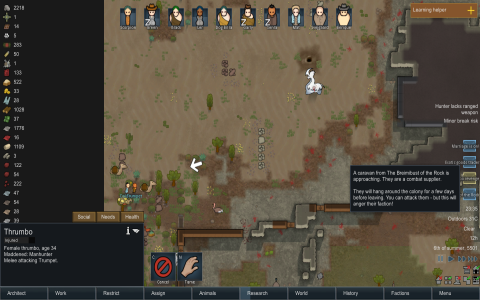
Thrumbo revenge aiming at foreign trade caravan, awesome timing
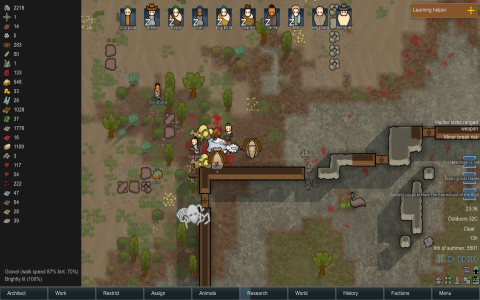
Black Ops success
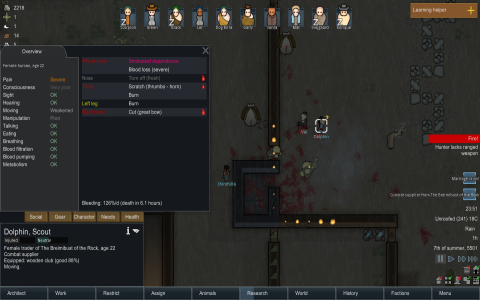
Foreign trade caravan with boomalopes, bad idea.


- Progression
- Quickstart Guides • Basics • Intermediate Midgame Guide • Advanced Endgame Guide • Ending the game
- Scenarios
- Lost Tribe Guide • Rich Explorer Guide • Naked Brutality Guide • The Mechanitor Guide • The Sanguophage Guide • The Odyssey Guide
- Survival
- Extreme Heat Guide • Extreme Cold Guide • Extreme Desert Guide • Ice Sheet Guide • Sea Ice Guide • Events Guide
- Combat
- Defense tactics • Offense tactics • Weapon Guide
- Construction
- Colony Building Guide • Defense structures
- Production
- Food production • Money making guide