Arid shrubland
Arid shrubland

A dry region, but not dry enough to become a true desert. Open plains with grasses and bushes give way to scattered groves of trees. Plants are hardy and there is a moderate density of animals, but arable soil is hard to find.
Base Stats
- Type
- Biome
- Texture on World Map

- Allows colonies
- Yes
- Allows Roads and Rivers
- Yes
- Animal Density
- 1.8
- Plant Density
- 0.24
- Disease MTB Days
- 65 days
- Movement Difficulty
- 1[Note]
- Forageability
- 50%
- Wild Plant Regrow Days
- 27 days
- Min Temperature
- -10 °C (14 °F)
- Max Temperature
- N/A
- Rainfall range
- 600mm – 2000mm
- Swampiness range
- N/A

- Clear
- 18
- Fog
- 1
- Rain
- 2
- Foggy rain
- 1
- Dry Thunderstorm
- 1
- Rainy Thunderstorm
- 1
- Soft snow
- 4
- Hard snow
- 4
- Gray Pall

- 1
- Sandstorm

- 2
- Max fish population
- 480
- Freshwater common
- Tilapia
- uncommon
- Catfish
- Saltwater common
- Bluefish
- uncommon
- Tuna
Arid shrubland is a hot and dry biome in RimWorld.
Summary[edit]
It features hot temperatures, frequent patches of low fertility terrain, a moderate amount of wildlife, and a sparse amount of trees.
In the lists below the number in brackets represents the relative commonality.
Flora[edit]
 Agave (0.2)
 Berry bush (0.1)
 Bush (0.7)
 Dandelions (0.8)
 Drago tree (0.2)
 Grass (7)
 Pincushion cactus (0.6)
 Saguaro cactus (0.26)
 Gray grass
 (5)
(5) Pebble cactus (0.6)
 Reeds (1)
Fauna[edit]
 Bison (0.1)
 Boomalope (0.5)
 Boomrat (0.5)
 Cougar (0.15)
 Donkey (0.2)
 Dromedary (0.7)
 Elephant (0.5)
 Emu (0.7)
 Fennec fox (0.15)
 Gazelle (0.7)
 Guinea pig (0.017)
 Hare (1.3)
 Horse (0.1)
 Iguana (0.7)
 Megasloth (0.1)
 Ostrich (0.7)
 Rat (1.3)
 Rhinoceros (0.5)
 Armadillo (0.2)
 Flamingo (0.5)
 Hippo (0.25)
 Monitor lizard (0.5)
 Quail (0.5)
 Sparrow (0.5)
 Vulture (0.5)
Additionally, these animals can spawn in coastal maps:
 Hermit crab (0.1)
 Sea turtle (0.1)
 Stone crab (0.1)
If the map is polluted, then the game may choose to spawn in wild animals from this list instead:


Diseases[edit]
Arid Shrubland has a disease MTB of 65 days. The following diseases can occur in an arid shrubland:
| Disease | Commonality |
|---|---|
| Flu | 100 |
| Plague | 100 |
| Gut worms | 60 |
| Muscle parasites | 60 |
| Fibrous mechanites | 30 |
| Sensory mechanites | 30 |
| Animal flu | 100 |
| Animal plague | 80 |
| Organ decay | 10 |
Fish[edit]
 |
This section relates to content added by Odyssey (DLC). Please note that it will not be present without the DLC enabled. |
The table below contains the list of all of the fish that can be caught - as well as where they can be caught.
| Fish | Water body | Rarity |
|---|---|---|
| Tilapia | Freshwater | Common |
| Catfish | Freshwater | Uncommon |
| Bluefish | Saltwater | Common |
| Tuna | Saltwater | Uncommon |
Analysis[edit]
Arid shrublands are one of the easier biomes in the game for a few reasons, with a few significant challenges. Abundant in natural resources except water and plants.
- Growing and Food: Easy - There is plenty of arable land, including patches of rich soil, growing is often year-round, and there is a moderate amount of animal life.
- Disease: Moderate - While diseases are less frequent in the arid shrubland, wild healroot does not grow, so medicine will be harder to acquire before healroot can be grown. Infections from injuries are unaffected by biome. Better doctors and not treating injuries with medicine can make the supply go further, but colonists will spend more time resting and sick. A lack of medicine won't kill immediately, but does kill unexpectedly.
- Temperature: Easy to Moderate - Average temperatures range from comfortable to desert-like, although even in a cooler arid shrubland, heat waves can be an issue. Unlike actual desert tiles, there are enough trees that passive coolers can be built in the early game or in a power outage. Electric coolers and dusters can solve the issue long-term. See Events Guide for more detail on how to deal with heat waves. It is rarely cold enough for cold snaps to appear.
- Fires: Easy - Arid shrubland's lower flora density reduces severity of natural fires. Rain is less common. [Factcheck]
- Predators: Easy - There are fewer natural human-hunting predators than temperate forest. Cougars are dangerous to humans but can be fended off with the right weapons, armor, or skilled colonists. Arid shrubland wildlife is relatively infrequent, large, and hardy, so can be dangerous if it turns aggressive, but not singularly so compared to other biomes.
Overall, the arid shrubland is easy to moderate difficulty. It has stable if overly warm temperatures, year-round or very long growing seasons, and is easy to traverse. It has full raw resources productivity but reduced rich soil growing zones. There are few unique challenges to living in the arid shrubland. It's not an especially easy place to live, but not uniquely so.
Trivia[edit]
Arid Shrublands were the only biome in the game until Alpha 6.
Gallery[edit]
An Arid Shrubland

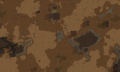
Arid shrubland's texture on the world map
Version history[edit]
- 0.6.532 - Added along with the biome system. Previously, all maps used the same map generation as arid shrubland.
- Temperate
- Temperate forest • Temperate swamp • Scarlands
- Hot
- Tropical rainforest • Tropical swamp • Arid shrubland • Desert • Extreme desert • Glowforest • Grassland • Lava field
- Cold
- Boreal forest • Cold bog • Tundra • Ice sheet • Sea ice • Glacial plain • Orbit
- Water
- Lake • Ocean
- Pocket map
- Underground • Labyrinth • Metal hell • Undercave • Insect lair