Greatwolf
 |
This article relates to content added by Odyssey (DLC). Please note that it will not be present without the DLC enabled. |
Greatwolf

A genetically engineered canine modeled on long-extinct dire wolves. These fearsome predators were created as pets for the glitterworld elite. Wild greatwolves now populate many planets, due to their tendency to escape confinement.
Base Stats
- Type
- Animal
- Market Value
- 500

- Flammability
- 70%
Pawn Stats
- Baby Name
- greatwolf puppy
- Combat Power
- 95
- Move Speed
- 5.50 c/s
- Health Scale
- 150% HP
- Body Size
- 1.5
- Mass - Baby
- 18 kg
- Mass - Juvenile
- 45 kg
- Mass - Adult
- 90 kg
- Carrying Capacity
- 112
- Filth Rate
- 2
- Hunger Rate
- 0.64 Nutrition/Day
- Diet
- carnivorous
- Life Expectancy
- 18 years
- Coastal Animal
- false
- Manhunter Chance
- 100%
- Manhunter Chance (Taming)
- 30%
- Trainable Intelligence
- Advanced
- Available Training
- Guard, Attack, Rescue, Haul, Attack target
- Wildness
- 95%
- Minimum Handling Skill
- 10
- Mate Interval
- 12 hours
- Maturity Age
- 0.5 years (30 days)
- Juvenile Age
- 0.2 years (12 days)
- Toxic Resistance
- 50%
- Toxic Environment Resistance
- 0%
- Comfortable Temp Range
- -50 °C – 40 °C (-58 °F – 104 °F)
Production
- Meat Yield
 210 greatwolf meat
- Leather Yield
 60 wolfskin
- Gestation Period
- 10 days
- Offspring Per Birth
- 1-3 (1.721 avg)
Melee Combat
- Attack 1
- Front left paw
10.9 dmg (Scratch)
16 % AP
2 second cooldown
0.5 chance factor
Stun for 280 ticks (4.67 secs) on first strike - Attack 2
- Front right paw
10.9 dmg (Scratch)
16 % AP
2 second cooldown
0.5 chance factor
Stun for 280 ticks (4.67 secs) on first strike - Attack 3
- Teeth
12 dmg (Bite)
18 % AP
2 second cooldown
0.9 chance factor
Stun for 280 ticks (4.67 secs) on first strike - Attack 4
- Head
6 dmg (Blunt)
9 % AP
2 second cooldown
0.2 chance factor - Average DPS
- 3.6332
- tradeTags
- AnimalUncommon, AnimalFighter
A greatwolf, called greatwolf puppy as a baby, is an animal added by the Odyssey DLC. It is similar to the timber wolf and arctic wolf but almost twice their size. It is also wilder, faster and hungrier.
Acquisition[edit]
Greatwolves can be found in boreal forests, cold bogs, tundra, and glacial plains. They can either be tamed by a handler or self-tame in a random event.
Greatwolves can be bought and sold in other faction bases and from exotic goods traders. Greatwolves purchased from traders will be already tamed.
Summary[edit]
A generalist animal suited for cold climates. Its stats make the greatwolf suited to locking enemies into melee. However due to the greatwolf poor DPS it needs to be supported by colonists to down enemies quickly. It`s high food consumption and carnivorous diet make them poor late game animals however.
Analysis[edit]
| Animal | Health Scale | DPS | Move Speed | Hunger rate | Training Decay |
|---|---|---|---|---|---|
| Greatwolf | 1.5 | 3.633 | 5.5 | 0.64 | 7.5 |
| Arctic wolf | 0.99 | 3.633 | 5 | 0.29 | 6.9 |
| Timber wolf | 0.99 | 3.633 | 5 | 0.29 | 6.9 |
| Scimitar cat | 1.5 | 4.675 | 6 | 0.42 | 7.2 |
| Husky | 1.05 | 3.119 | 5 | 0.8 | 12 |
| Polar bear | 2.5 | 5.375 | 4.6 | 0.56 | 6.9 |
The biggest downside is the greatwolf`s high food consumption of 0.64 but due to being a carnivore it can eat human corpses, which due to its native cold climate can be relatively easily stored. Its notable stats are high speed and somewhat high HP (relative to its competitors).
Compared to a husky it is strictly better for combat and hauling but it is a carnivore whereas the husky is an omnivore.
While having higher HP than similar animals, it is still relatively fragile. For use as a tank, polar bears should be the more favored animals. Notably the polar bear requires less food in spite of having more HP.
For purely combat the Scimitar cat is superior due to higher speed, lower body size and higher DPS. The main advantage of the greatwolf is faster breeding due to having an average of 1.721 average offspring per birth compared to the just 1 of the Scimitar cat. While not as individually dangerous as a Scimitar cat, it instead compensates with greater numbers.
Training[edit]
This animal can be trained as follows:
 Guard: Guard:
|

|
|---|---|
 Attack: Attack:
|
|
 Rescue: Rescue:
|
|
 Haul: Haul:
|
|
 Attack target: Attack target:
|
|
*As of version 1.1.2610, all animals can be tamed. The percentage of likelihood of success depends on factors such as the Animals Wildness Percentage, Pawn Handling Skill, and others. More information can be found on the animals page.
Health[edit]
The body part table is collapsed due to length. Expand to view.
| Part Name | HP | N° | C[1] | TC[2] | Subpart of | Internal | Capacity[3] | Effect if Destroyed/Removed |
|---|---|---|---|---|---|---|---|---|
| Body | 60 | 1 | 100% | 21% | N/A[4] |  |
- | Death |
| Tail | 15 | 1 | 7% | 7% | Body | |
- | - |
| Spine | 37.5 | 1 | 3% | 3% | Body | |
Moving |
−100% Moving[5] |
| Stomach | 30 | 1 | 3% | 3% | Body | |
Digestion |
−50% Digestion |
| Heart | 22.5 | 1 | 3% | 3% | Body | |
Blood Pumping |
Death |
| Lung | 22.5 | 2 | 3% | 3% | Body | |
Breathing |
−50% Breathing. Death if both lost. |
| Kidney | 22.5 | 2 | 3% | 3% | Body | |
Blood Filtration | −50% Blood Filtration. Death if both lost. |
| Liver | 30 | 1 | 3% | 3% | Body | |
Digestion |
Death |
| Neck | 37.5 | 1 | 20% | 5% | Body | |
Eating Talking Breathing |
Death |
| Head | 37.5 | 1 | 75% | 2.25% | Neck | |
- | Death |
| Skull | 37.5 | 1 | 25% | 1.125% | Head | |
- | Cannot be destroyed Increasing Pain based on damage. |
| Brain | 15 | 1 | 70% | 2.625% | Skull | |
Consciousness |
Death Damage always results in scarring. |
| Eye | 15 | 2 | 12% | 1.8% | Head | |
Sight |
−25% Sight. −100% if both lost. Damage always results in scarring. 0% Hit Chance against Blunt damage. |
| Ear | 18 | 2 | 8% | 1.2% | Head | |
Hearing |
−25% Hearing. −100% if both lost. |
| Nose | 15 | 1 | 10% | 1.5% | Head | |
- | - |
| AnimalJaw | 15 | 1 | 10% | 1.5% | Head | |
Manipulation |
−100% Manipulation. Can no longer use Bite attack. |
| Front Leg | 45 | 2 | 7% | 5.95% | Body | |
Moving |
−25% Moving. −50% if both lost. Can no longer use paw attack.[6] |
| Front Paw | 15 | 2 | 15% | 1.05% | Front Leg | |
Moving |
−25% Moving. −50% if both lost. Can no longer use paw attack. |
| Rear Leg | 45 | 2 | 7% | 5.95% | Body | |
Moving |
−25% Moving. −50% if both lost. |
| Rear Paw | 15 | 2 | 15% | 1.05% | Rear Leg | |
Moving |
−25% Moving. −50% if both lost. |
- ↑ Coverage determines the chance to hit this body part. It refers to the percentage of the super-part that this part covers, before its own sub-parts claim their own percentage. For example, if the base coverage of the super-part is 100%, and the coverage of the part is 20%, 20% of hits would hit the part, and 80% the super-part. If the part had its own sub-part with 50% coverage, the chances would be 10% sub-part, 10% part, 80% super part.
- ↑ Target Chance is the actual chance for each part to be be selected as the target when each part's coverage has been taken into account(I.E. Neck covers 7.5% of Torso but Head covers 80% of Neck so it actually has only a 1.5% chance to be selected). This is not pure hit chance, as different damage types propagate damage in different ways. See that page for details.
- ↑ Note that capacities can affect other capacities in turn. Only the primary effect is listed. See specific pages for details.
- ↑ This is the part that everything else connects to to be considered 'connected'.
- ↑ If Moving drops below 16% a pawn cannot move.
- ↑ A Scratch attack that varies from animal to animal. Each front paw allows one attack.
Attack table
 Greatwolf Greatwolf
| ||||||
|---|---|---|---|---|---|---|
| Attack (Damage type) |
DPS[1] (Post Hit Chance)[2] |
Dam. | Cool. | AP | Selection chance[3] | |
| Average | 5.86 (3.63) |
- | - | 17.5% | - | |
| Front left paw (Scratch) |
5.45 (3.38) |
10.9 | 2s | 16% | 12.5% | |
| Front right paw (Scratch) |
5.45 (3.38) |
10.9 | 2s | 16% | 12.5% | |
| Teeth (Bite) |
6 (3.72) |
12 | 2s | 18% | 75% | |
| Head (Blunt) |
3 (1.86) |
6 | 2s | 9% | 0% | |
- ↑ Note: This is the actual base average derived from the melee verb system updated in 1.1.2610, it may sometimes disagree with the listed value in the in-game infobox.
It may also change depending on the stats and the melee verbs available to the pawn. - ↑ Assuming a melee hit chance of 62%
- ↑ Chance for attack to be selected. It may change depending on the melee verbs available to the pawn.
Gallery[edit]
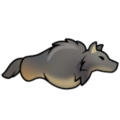
Facing east
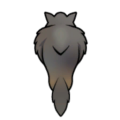
Facing north
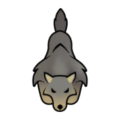
Facing south


Desiccated facing east
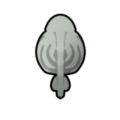
Desiccated facing north
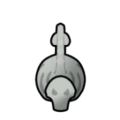
Desiccated facing south


Version history[edit]
- Odyssey DLC Release - Added.
- Herbivorous
- Alpaca • Bison • Boomalope • Capybara • Caribou • Cassowary • Chicken • Chinchilla • Cow • Deer • Donkey • Dromedary • Duck • Elephant • Elk • Emu • Gazelle • Goat • Goose • Guinea pig • Hare • Horse • Ibex • Megasloth • Muffalo • Ostrich • Rhinoceros • Sheep • Snowhare • Squirrel • Turkey • Yak • Toxalope
 • Bluebird • Hippo • Lava snail • Macaw • Mastodon • Moose • Muskox • Panda • Peafowl • Porcupine • Prairie dog • Quail • Sparrow • Swan
 - Omnivorous
- Boomrat • Grizzly bear • Human • Husky • Iguana • Labrador retriever • Megascarab • Megaspider • Monkey • Pig • Polar bear • Spelopede • Raccoon • Rat • Tortoise • Wild boar • Yorkshire terrier • Waste rat • Bog hound • Monitor lizard • Armadillo • Badger • Bullfrog • Colossus toad • Crow • Flamingo • Gorilla • Hermit crab • Heron • Hive queen • Larva • Locust • Megavole • Mink • Otter • Sea turtle • Stone crab
- Carnivorous
- Arctic fox • Arctic wolf • Cat • Cobra • Cougar • Fennec fox • Lynx • Panther • Red fox • Timber wolf • Warg • Alligator • Greatwolf • Penguin • Scimitar cat • Sea lion • Seal • Tiger • Vulture • Walrus • Wolverine
- Dryads

- Barkskin • Berrymaker • Carrier • Clawer • Gaumaker • Immature dryad • Medicinemaker • Woodmaker